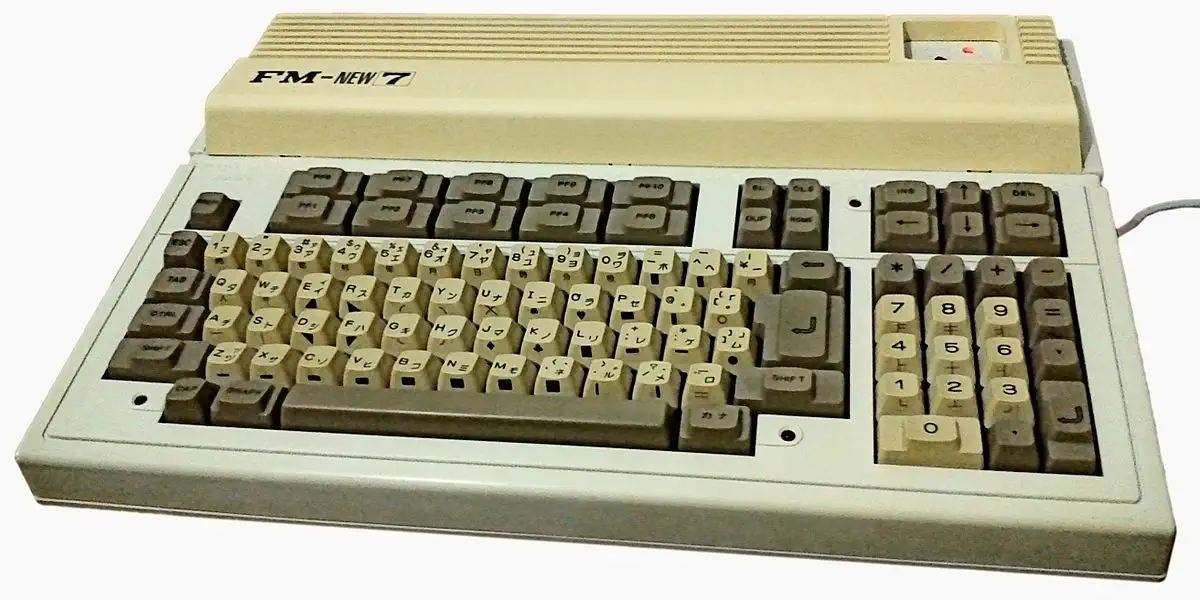

Fujitsu FM-7
The FM-7 ("Fujitsu Micro 7") is a home computer created by Fujitsu. It was first released in 1982 and was sold in Japan and Spain. It is a stripped-down version of Fujitsu's earlier FM-8 computer,[2] and during development it was referred to as the "FM-8 Jr.".
Although it was designed to be a cut-down version of the FM-8 (with the FM-7 costing 126,000 yen, compared to 218,000 yen for the FM-8), most notably removing the (expensive) bubble memory technology, the FM-7 was given a more advanced AY-3-8910 sound chip capable of three voice sound synthesis, leading to a strong uptake among the hobbyist computer market in Japan and making it a more popular system than the FM-8.
The FM-7 primarily competed with the NEC PC-8801 and Sharp X1 series of computers in the early 1980s. It was succeeded by the FM-77 series of computers in 1984, which featured backwards compatibility with the FM-7. The FM-77 series was later succeeded by the 32-bit FM Towns in 1989.
The FM-7 is based around the 6809 chip, which was also used in home computers such as the TRS-80 Color Computer and Dragon 32/64, as well as several arcade games. The computer has two MC68B09 CPUs running at 2MHz. One was used as central CPU, the other as graphics processor
The FM-7 ran the OS-9 Operating Sytem, which is compatible with the Tandy Color Computer
Fujitsu BASIC (F-BASIC)
F-BASIC was Fujitsu’s house-branded dialect of Microsoft BASIC, supplied with the FM-7 and its successors. Like other Microsoft-derived implementations of the period, it resided in ROM and acted as the default operating environment at power-on. Users interacted with the machine almost entirely through this language, issuing commands to load or save programs, manipulate graphics and sound hardware, or run application code. For many owners, F-BASIC was effectively synonymous with the FM-7 itself, since no separate operating system was required to make practical use of the machine.
What set F-BASIC apart from earlier 8-bit BASICs was its extensive support for the FM-7’s advanced hardware. It included commands for high-resolution graphics modes, multiple color palettes, and even limited sprite and sound features. This integration meant that games, educational titles, and business programs could be written and run directly from the BASIC prompt without relying on assembly unless higher performance was necessary. Compared to the Apple II’s Integer BASIC or early Commodore BASIC, F-BASIC gave users more direct access to the multimedia features of the system.
Later versions of F-BASIC evolved alongside the FM series, particularly the FM-77 models, where extensions added disk commands, structured program features, and better handling of memory management. These improvements aligned it with contemporary trends in microcomputer BASICs, where the language was expanding from a teaching tool into a general software platform. As a result, F-BASIC was not just an introductory environment but also a foundation for serious applications, with commercial software written and distributed in it throughout the 1980s Japanese microcomputer market.
OS-9
OS-9 was a real-time, multi-user, multitasking operating system developed by Microware for Motorola 6809-based machines in the early 1980s. It was designed with modularity in mind: core functions like process management, device drivers, and file managers were structured as separately loadable modules. This meant that OS-9 could be easily adapted to a wide variety of hardware configurations, and could run in environments with very limited memory. Its architecture made it suitable not only for home computers, but also for embedded systems and industrial controllers, where deterministic response and efficient use of hardware resources were crucial.
OS-9 Level One provided a Unix-like environment within the constraints of a 64 KB address space. It supported hierarchical directories, process scheduling, and a command-line shell, features rarely seen on 8-bit home computers at that time. Unlike the single-tasking BASIC ROMs most users were familiar with, OS-9 allowed multiple processes to run concurrently, enabling tasks like background printing while editing a document. This OS-9 implementation relied on the 6809’s relatively advanced instruction set and efficient interrupt handling, making it possible to deliver true multitasking in a very constrained environment.
Although its user base was small compared to more consumer-friendly Operating Systems, OS-9 appealed to advanced users and developers who valued its Unix-like design and flexibility. It became a development platform for higher-level languages such as C, and for utilities that benefitted from pre-emptive multitasking. The Dragon’s OS-9 port also helped demonstrate the 6809’s capabilities, as the processor was widely regarded as one of the most sophisticated 8-bit CPUs of its era. OS-9 would later evolve into Level Two for 6809 and 68000 machines, maintaining continuity between small hobbyist systems (like the FM-series, Dragon Computers, Tandy Color Computers) and larger professional workstations.
Sound - The AY-3-8910 PSG
The AY-3-8910 is a 3-voice Programmable Sound Generator, or PSG. It was designed by General Instruments in 1978 for use with their own 8-bit PIC1650 and their 16-bit CP1610 computers.
The PSG is widely used in many arcade cabinets, pinball machines, and many micro-computers. Here is a list of some of the major brands of computer that used the AY-3-8910:
- Intellivision
- Vectrex
- Amstrad CPC range
- Oric-1
- Color Genie
- Elektor TV Games Computer
- All MSX-1 and MSX-2 computers
- ZX Spectrum home computers
General Instrument spun of MicroChip Technology in 1987 and the chip was sold under the MicroChip brand, and licensed to Yamaha as the YM2149F which the Atari ST range of computers use. Functionally the PSG is very similar to the Texas Instruments SN76489.
Variants:
-
AY-3-8910
Comes with 2 general purpose 8-bit parallel I/O ports, used for Keyboard and Joystick in for instance MSX. -
AY-3-8912
Same chip, but in a 28-pin package. Parallel port B is not connected to save cost and space. -
AY-3-8913
Same chip, but in a 24-pin package. Both parallel ports are not connected. -
AY-3-8914
The AY-3-8914 has the same pinout and is in the same 40-pin package as the AY-3-8910, except the control registers on the chip are shuffled around, and the 'expected input' on the A9 pin may be different. It was used in Mattel's Intellivision console and Aquarius computer. -
AY-3-8930
Backwards compatible but BC2 pin is ignored
YM2149F -
YM3439-D
CMOS version of the Y2149 in 40-pin DIP -
YM3439-F
CMOS version of the Y2149 in 44-pin QFP -
YMZ294
Variant of the YM3249 in an 18-pin package. Parallel ports not connected, and all sound channels mixed on 1 port. -
T7766A
Toshiba variant of the AY-3-8910, fully compatible. Used in some MSX models. - Winbond WF19054, JFC95101, and File KC89C72: Fully compatible versions of the AY-3-8910 produced for slot machines.
Yamaha Produced chip, same pin-out as the AY-3-8910, but pin 26 could halve the master clock. Can be used to replace the AY-3-8910 if pin 26 is left disconnected.
CPU - The Motorola 6809
The Motorola 6809 is an 8-bit microprocessor with some 16-bit features. It was designed by Motorola's Terry Ritter and Joel Boney and introduced in 1978. Although source compatible with the earlier Motorola 6800, the 6809 offered significant improvements over it and 8-bit contemporaries like the MOS Technology 6502, including a hardware multiplication instruction, 16-bit arithmetic, system and user stack registers allowing re-entrant code, improved interrupts, position-independent code and an orthogonal instruction set architecture with a comprehensive set of addressing modes.
ROM: 40kB
000