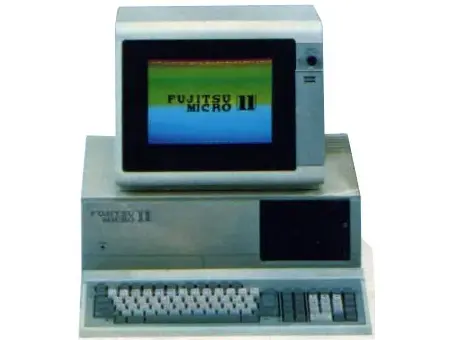

Fujitsu FM-11
The FM-11 (Fujitsu Micro 11) was a business computer announced by Fujitsu in November 1982. It is a higher-end model of their previous FM-8 computer, and was released simultaneously with the mass-market FM-7 machine. The FM-11 series was intended to be used in offices.
Japanese characters can be displayed within a 16x16 pixels matrix.
The Fujitsu FM-11 was designed to be more flexible in its operating system support than its home-computer sibling. This was possible because the FM-11 combined a Motorola 6809 CPU with an optional Intel 8088 coprocessor card, which let it run both 8-bit and 16-bit operating systems.
On the 6809 side, the FM-11 could run F-BASIC in ROM as its default environment, just like the FM-7, but it was also compatible with OS-9, the multitasking, multiuser operating system tailored for the 6809. For business applications that needed CP/M compatibility, it supported CP/M-80–style systems via the 6809 as well. This gave the FM-11 continuity with existing 8-bit software.
With the 8088 expansion, the FM-11 could also run CP/M-86 and MS-DOS, giving it access to the growing IBM PC–class software ecosystem. This made the machine attractive in office environments that needed both Japanese domestic software (often written for OS-9 or F-BASIC) and international business packages that were emerging on DOS. Over its lifespan, the FM-11 line became known for supporting F-BASIC, OS-9, CP/M (both 80 and 86), and MS-DOS, with different variants and expansions emphasizing one side or the other depending on configuration.
Models
- FM-11 EX: 6809 & 8088 dual CPUs
- FM-11 AD: 6809 CPU only
- FM-11 ST: Economy version of the AD, FDD is optional
- FM-11 BS: 8088 CPU only
- FM-11 AD2: OS-9 OS
- FM-11 AD2+: Enhanced AD2 with 256KByte RAM
Fujitsu BASIC (F-BASIC)
F-BASIC was Fujitsu’s house-branded dialect of Microsoft BASIC, supplied with the FM-7 and its successors. Like other Microsoft-derived implementations of the period, it resided in ROM and acted as the default operating environment at power-on. Users interacted with the machine almost entirely through this language, issuing commands to load or save programs, manipulate graphics and sound hardware, or run application code. For many owners, F-BASIC was effectively synonymous with the FM-7 itself, since no separate operating system was required to make practical use of the machine.
What set F-BASIC apart from earlier 8-bit BASICs was its extensive support for the FM-7’s advanced hardware. It included commands for high-resolution graphics modes, multiple color palettes, and even limited sprite and sound features. This integration meant that games, educational titles, and business programs could be written and run directly from the BASIC prompt without relying on assembly unless higher performance was necessary. Compared to the Apple II’s Integer BASIC or early Commodore BASIC, F-BASIC gave users more direct access to the multimedia features of the system.
Later versions of F-BASIC evolved alongside the FM series, particularly the FM-77 models, where extensions added disk commands, structured program features, and better handling of memory management. These improvements aligned it with contemporary trends in microcomputer BASICs, where the language was expanding from a teaching tool into a general software platform. As a result, F-BASIC was not just an introductory environment but also a foundation for serious applications, with commercial software written and distributed in it throughout the 1980s Japanese microcomputer market.
CP/M-86 Operating System
CP/M-86 was the 16-bit successor to Gary Kildall’s original CP/M (Control Program for Microcomputers), which had dominated the 8-bit microcomputer market in the late 1970s. Introduced in 1981, CP/M-86 was adapted to run on Intel’s 8086 and 8088 processors, providing a familiar environment for developers and users migrating from 8-bit systems like the Intel 8080 and Zilog Z80. It retained the fundamental architecture of CP/M: a resident operating system split into the BIOS (hardware-dependent routines), BDOS (the core file and device management logic), and the CCP (Console Command Processor, which provided the user’s command interface). With this modular design, vendors could customize CP/M-86 for their hardware while maintaining compatibility with application binaries.
Technically, CP/M-86 offered a flat file system with 8.3 filename conventions, sequential or random file access methods, and support for user areas (a primitive form of directory segmentation). The BDOS interface provided consistent system calls for file manipulation, console I/O, and device access, allowing software to be written once and deployed across different machines. Because the 8086 architecture used segmented memory addressing, CP/M-86 had to manage memory in 64 KB segments, but unlike MS-DOS it did not adopt the same FCB (File Control Block) compatibility hacks. Instead, it extended some of its BDOS functions to better utilize the wider word size of the 16-bit environment, though its lineage remained evident in the command set and utility structure inherited from the 8-bit CP/M.
Despite its technical merits, CP/M-86 struggled in the marketplace. It was priced higher than Microsoft’s competing MS-DOS and often shipped later than DOS on the same hardware, such as the IBM PC. While CP/M-86 could run a growing library of native software and offered a smoother transition for CP/M-80 developers, its limited adoption meant fewer commercial applications and reduced support over time. By the mid-1980s, MS-DOS had effectively displaced CP/M-86, though its influence persisted in the modular OS structure and command conventions that many users carried forward. For retrocomputing enthusiasts, CP/M-86 represents an intriguing “what-if” moment—an alternate trajectory where the dominant 8-bit operating system of the late ’70s attempted to evolve into the 16-bit world but was ultimately overshadowed by Microsoft’s more aggressively marketed DOS.
MS-DOS Operating System
MS-DOS (Microsoft Disk Operating System) originated in 1981 when Microsoft acquired QDOS (Quick and Dirty Operating System) from Seattle Computer Products and adapted it for IBM’s upcoming 8088-based personal computer. Initially branded as IBM PC-DOS 1.0 for IBM, and MS-DOS for other vendors, it provided a single-user, single-tasking environment that was heavily inspired by CP/M. The system was structured around a kernel (IBMBIO.COM and IBMDOS.COM in PC-DOS, IO.SYS and MSDOS.SYS in MS-DOS) that interfaced with hardware and implemented system services, plus a command interpreter (COMMAND.COM) that offered a user interface and executed batch files. Early versions supported only 160 KB or 320 KB floppy disks, a flat directory structure, and a very limited system call API.
Technically, MS-DOS was designed around the Intel 8086/8088’s segmented memory model, giving programs access to up to 640 KB of conventional memory, with the upper memory area reserved for system BIOS and hardware. The OS itself was not re-entrant and offered no process isolation: a single foreground program owned the machine at any given time, and the kernel simply provided file and device I/O calls. Devices were abstracted as special files (CON, PRN, AUX, NUL), allowing consistent access via the same system calls used for disk files. Its filesystem, FAT12, offered a simple, space-efficient design suitable for floppy media but imposed limits such as 8.3 filenames and small maximum volume sizes.
As the IBM PC platform expanded, MS-DOS evolved rapidly. Version 2.0 (1983), designed for the IBM XT with a hard drive, introduced FAT16, hierarchical subdirectories, file handles, and device drivers that could be dynamically loaded. Later releases added support for larger disks, expanded memory (via EMS/XMS standards), internationalization, and more sophisticated batch scripting. Version 3.x aligned with the IBM AT and its 80286 CPU, supporting 1.2 MB floppies, larger hard disks, and network redirectors. By version 4.0, MS-DOS began showing signs of strain under the growing complexity of PC hardware, and memory management became a recurring challenge due to the 640 KB conventional memory limit and the awkward use of extended and expanded memory schemes.
Despite being inherently single-tasking, MS-DOS was extended through third-party multitasking shells and Microsoft’s own attempts such as MS-DOS 4.0 Multitasking (rarely used). Eventually, MS-DOS served as the underlying runtime for Windows 3.x, which leveraged DOS for file and device I/O but implemented a cooperative multitasking GUI environment on top. With the release of Windows 95 and later, MS-DOS was gradually absorbed into Windows as a bootstrapping layer and compatibility subsystem. Nonetheless, MS-DOS’s simple architecture, reliance on BIOS and device drivers, and its widespread adoption made it the de facto standard for microcomputer operating systems throughout the 1980s, shaping software design and hardware standards for years to come.
OS-9
OS-9 was a real-time, multi-user, multitasking operating system developed by Microware for Motorola 6809-based machines in the early 1980s. It was designed with modularity in mind: core functions like process management, device drivers, and file managers were structured as separately loadable modules. This meant that OS-9 could be easily adapted to a wide variety of hardware configurations, and could run in environments with very limited memory. Its architecture made it suitable not only for home computers, but also for embedded systems and industrial controllers, where deterministic response and efficient use of hardware resources were crucial.
OS-9 Level One provided a Unix-like environment within the constraints of a 64 KB address space. It supported hierarchical directories, process scheduling, and a command-line shell, features rarely seen on 8-bit home computers at that time. Unlike the single-tasking BASIC ROMs most users were familiar with, OS-9 allowed multiple processes to run concurrently, enabling tasks like background printing while editing a document. This OS-9 implementation relied on the 6809’s relatively advanced instruction set and efficient interrupt handling, making it possible to deliver true multitasking in a very constrained environment.
Although its user base was small compared to more consumer-friendly Operating Systems, OS-9 appealed to advanced users and developers who valued its Unix-like design and flexibility. It became a development platform for higher-level languages such as C, and for utilities that benefitted from pre-emptive multitasking. The Dragon’s OS-9 port also helped demonstrate the 6809’s capabilities, as the processor was widely regarded as one of the most sophisticated 8-bit CPUs of its era. OS-9 would later evolve into Level Two for 6809 and 68000 machines, maintaining continuity between small hobbyist systems (like the FM-series, Dragon Computers, Tandy Color Computers) and larger professional workstations.
CPU - The Intel 8088
The Intel 8088 microprocessor is a variant of the Intel 8086. The 8088 has an 8-bit external bus instead of the 16-bit bus that the 8086 has. The 16-bit registers and the 1MByte address range are unchanged, however. The 8086 and the 8088 have the same execution unit (EU), only the Bus Interface Unit (BIU) differs.
The original IBM PC architecture is based on the Intel 8088. The CPU runs at 5 to 16 MHz, has a 20-bit address bus and can work together with the 8087 Co-Processor. The 8088 was launched in 1979. The 8088 is compatible with the Intel 8085.
CPU - The Motorola 6809
The Motorola 6809 is an 8-bit microprocessor with some 16-bit features. It was designed by Motorola's Terry Ritter and Joel Boney and introduced in 1978. Although source compatible with the earlier Motorola 6800, the 6809 offered significant improvements over it and 8-bit contemporaries like the MOS Technology 6502, including a hardware multiplication instruction, 16-bit arithmetic, system and user stack registers allowing re-entrant code, improved interrupts, position-independent code and an orthogonal instruction set architecture with a comprehensive set of addressing modes.
68B09E @2MHz
RAM max: 1MB
OS-9
MS-DOS
000