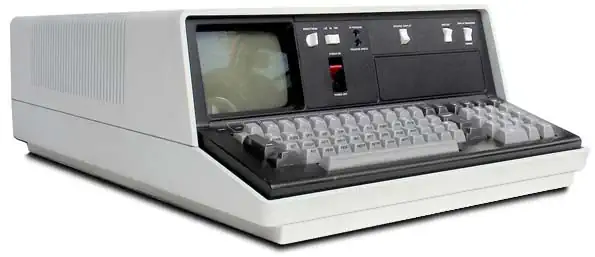

The IBM 5110 succeeded the IBM 5100. The main difference between the 5100 and the 5110 was that the 5110 supported more I/O devices (floppy disk drives, IEEE-488, RS-232) and a character set that was compatible with other IBM machines. Because of this the 5110 was not completely compatible with its predecessor.
Three variations of the 5110 were built:
- Model 1, with a built-in QIC DC300 204kB Tape Drive.
- Model 2, without the QIC drive
- Model 3, with two built-in 8" 1.2 MB Floppy Disk Drive. Functionally the same as the IBM 5120, but with a smaller screen)
The 5110 featured the same housing as the 5100, but different colors. The machine contained the IBM PALM processor, and had a 1024 character display screen. Main memory started at 16kB and was expandable up to 64kB. The QIC drive that came with Model 1 was capable of storing 204,000 bytes of information per tape cartridge. Model 2 only allowed diskette storage. Up to two IBM 5114 diskette units could be attached to the machine for a total disk capacity of 4.8MByte. The Model 3 only allowed one external IBM 5114 diskette unit. The 5110 line did not support hard disks or network capabilities.
The 5110 came with either APL or BASIC as programming languages in ROM. Machines that were equipped with both featured a toggle switch on the front panel to select the language. In 1984, Core International, Inc introduced PC51, software that allowed 5100 Series computer programs written in BASIC to run unmodified on the IBM PC and compatibles under PC DOS.
PALM (Program All Logic in Microcode)
The PALM processor (Program All Logic in Microcode) was a 16-bit CPU developed by IBM. It was used in the IBM 5100 Portable Computer line, a predecessor to the IBM PC. The PALM processor was also used in other IBM products as an embedded controller.
IBM referred to PALM as a microprocessor. In IBMs terminology this meant a processor that executes microcode to implement a higher-level instruction set, rather than its conventional definition of a CPU. The PALM processor was a circuit board containing 13 bipolar gate arrays packaged in square metal cans, 3 conventional transistor-transistor logic ICs in dual in-line packages, and 1 round metal can part.
The PALM was used to implement an emulator, which in turn coulrd run machine instructions written for other machines; this is how IBM System/360 APL ran on the 5100 machine.
The PALM has a 16-bit data bus, with two additional parity bits. PALM can directly address 64kByte of memory. The IBM 5100 could be configured with up to 64+ kB (APL + BASIC) Executable ROS (ROM), and up to 64kB of RAM. A bank switching scheme was used to extend the address space.
RAM max: 64kB
BASIC