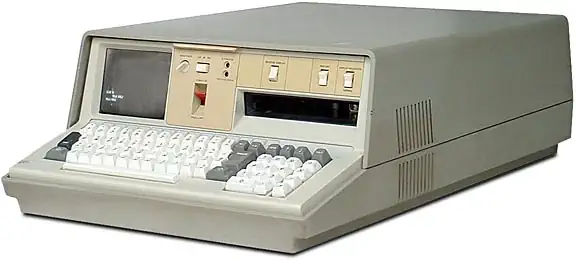

The IBM 5100 Portable Computer, introduced in September 1975 by IBM, is widely regarded as one of the earliest portable computers. Although it weighed around 50 pounds (about 23 kg), it was revolutionary for its time because it integrated a keyboard, a small CRT display, storage, and computing hardware into a single self-contained unit. Prior to machines like the 5100, most computers required large rooms and separate terminals. The 5100’s compact design allowed engineers, scientists, and analysts to bring computing power directly to laboratories, offices, and field locations.
Technically, the IBM 5100 was built around a proprietary processor derived from IBM’s minicomputer technology and came with between 16 KB and 64 KB of RAM, which was substantial for the mid-1970s. It included a built-in 5-inch CRT display that showed 16 lines of 64 characters and used tape cartridges for data storage. A key feature of the system was that it supported both the programming languages APL and BASIC, stored in ROM. This allowed users to perform mathematical analysis, engineering calculations, and data manipulation without needing access to a large mainframe.
Despite its innovative design, the IBM 5100 was expensive, with prices ranging roughly from $9,000 to nearly $20,000 depending on configuration (equivalent to tens of thousands of dollars today). As a result, it was primarily used by specialized professionals rather than the general public. Nevertheless, the system represented an important step toward personal computing, demonstrating that a complete computer could be packaged into a single portable device. Its legacy helped pave the way for later personal computers that would become common in homes and offices during the late 1970s and early 1980s.
PALM (Program All Logic in Microcode)
The PALM processor (Program All Logic in Microcode) was a 16-bit CPU developed by IBM. It was used in the IBM 5100 Portable Computer line, a predecessor to the IBM PC. The PALM processor was also used in other IBM products as an embedded controller.
IBM referred to PALM as a microprocessor. In IBMs terminology this meant a processor that executes microcode to implement a higher-level instruction set, rather than its conventional definition of a CPU. The PALM processor was a circuit board containing 13 bipolar gate arrays packaged in square metal cans, 3 conventional transistor-transistor logic ICs in dual in-line packages, and 1 round metal can part.
The PALM was used to implement an emulator, which in turn coulrd run machine instructions written for other machines; this is how IBM System/360 APL ran on the 5100 machine.
The PALM has a 16-bit data bus, with two additional parity bits. PALM can directly address 64kByte of memory. The IBM 5100 could be configured with up to 64+ kB (APL + BASIC) Executable ROS (ROM), and up to 64kB of RAM. A bank switching scheme was used to extend the address space.
RAM max: 64kB
ROM: 32-64kB
BASIC