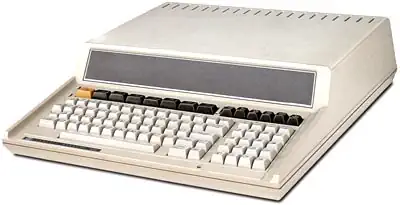

Hewlett Packard Model 86
The Hewlett-Packard HP-86, introduced in 1982 as part of the Series 80 lineup, was designed to offer enhanced flexibility and performance over its predecessor, the HP-85. Unlike the HP-85, which featured an integrated display and peripherals, the HP-86 was built to accommodate external components, allowing users to connect their choice of monitors and printers. This modularity made it suitable for a variety of professional applications, particularly in engineering and scientific fields.
Technical Capabilities
The HP-86 ran on the proprietary 8-bit Capricorn processor running at 625 kHz. The initial model, the HP-86A, came with 64 KB of RAM and included built-in interfaces for diskette drives and a Centronics printer port. The subsequent HP-86B model increased the RAM to 128 KB and featured an integrated HP-IB (Hewlett-Packard Interface Bus) port, enhancing its connectivity with various peripherals. Both models supported high-resolution graphics and offered expansion slots for additional ROM modules, enabling users to customize the system with advanced functionalities such as matrix operations and mass storage management.Expandability and Costomization
The HP-86's design emphasized expandability and user customization. Its external monitor support allowed for larger display options compared to the HP-85's built-in screen, and the increased memory capacity facilitated more complex computations and data handling. The availability of various ROM extensions and hardware accessories, including CP/M operating system compatibility through an optional Z80 processor card, made the HP-86 a versatile tool for professionals requiring a reliable and adaptable computing platform in the early 1980s.CPU - HP Capricorn
The Capricorn CPU, designed by Hewlett-Packard for the HP-85 and related Series 80 desktop machines, was a 16-bit architecture implemented largely with bit-serial logic. Internally, the arithmetic logic unit processed one bit at a time, reducing the required hardware complexity at the cost of throughput. The instruction set was tailored for efficient execution of HP BASIC and control tasks, with rich support for decimal arithmetic and string manipulation. Its addressing modes were limited compared to general-purpose CPUs, reflecting its orientation toward high-level language execution and instrument control. The processor typically operated at about 625 kHz, but because of its bit-serial ALU, the effective performance per instruction was considerably lower than that figure might suggest. In the HP Model 85, the CPU ran at a modest 625 kHZ.
When compared to mainstream CPUs of the late 1970s and early 1980s, the Capricorn occupied a unique niche. An Intel 8085 or MOS 6502 at 1 MHz could generally outperform it in raw instruction throughput, since those processors used parallel 8-bit ALUs and had well-tuned instruction pipelines for typical control tasks. The Zilog Z80, also an 8-bit design, offered richer instruction decoding and faster execution of complex operations than Capricorn. On the other end of the spectrum, the Motorola 68000 family, appearing in 1979–1980, delivered true 16-bit external data paths, 32-bit registers, and significantly higher performance at clock rates of 4–8 MHz. Compared to these, Capricorn traded raw speed for simplicity and integration into a tightly controlled system.
HP’s design philosophy with Capricorn paralleled other proprietary CPU efforts in scientific and industrial contexts, where compatibility with existing software ecosystems was less important than providing deterministic performance for specialized applications. While slower than contemporaries like the 6502, Z80, or even the 8086, the Capricorn CPU could efficiently run HP BASIC in ROM and interface smoothly with the HP-IB (GPIB/IEEE-488) bus for instrumentation. Its focus on bit-serial execution and high-level language support made it unusual but well-matched to the HP-85’s role as an engineering desktop machine. In contrast to the general-purpose microprocessors that enabled the personal computer revolution, Capricorn illustrates how proprietary architectures persisted in vertical markets where integration and reliability outweighed the need for compatibility or maximum speed.
RAM max: 64kB
ROM: 32kB
256x192 Graphics