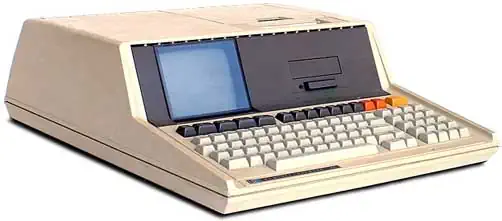

Hewlett Packard Model 85
The Hewlett-Packard HP-85, released in 1980, was a groundbreaking personal computer that exemplified Hewlett-Packard's innovative approach to technology. Compact and portable for its time, the HP-85 was equipped with a built-in 5-inch CRT display, a thermal printer, and a tape drive for storage, making it a self-contained computing system. Its compact design targeted engineers, scientists, and small business owners who needed powerful computational capabilities in a standalone unit. Unlike many contemporary computers that required external peripherals for basic functionality, the HP-85’s all-in-one design set it apart and made it particularly appealing for technical professionals.
Technical Capabilities
Powered by the proprietary HP-developed processor running at 625 kHz, the HP-85 utilized an operating system stored in read-only memory (ROM), ensuring quick boot times and ease of use. The computer featured a BASIC programming language interpreter, which allowed users to write and execute custom programs for calculations, data analysis, and even automation tasks. It had 16 KB of RAM as standard, expandable to 64 KB, which, while modest by today's standards, was sufficient for the computing needs of its era. Its innovative use of magnetic tape cartridges for data storage provided an efficient and reliable alternative to floppy disks, which were still in their infancy at the time.Expandability
The HP-85 was also notable for its expandability and integration with Hewlett-Packard’s extensive range of peripherals and modules. Users could enhance the computer’s capabilities with plug-in ROM cartridges that added specialized functions, such as matrix calculations and advanced plotting. Additionally, the HP-85 could interface with HP’s suite of measurement and testing equipment, making it a favorite among engineers. Though its price tag of around $3,250 made it a premium product, its versatility and robust feature set secured its place as a pivotal early personal computer and a significant milestone in the evolution of computing.HP-83
In 1982 Hewlett-Packard came out with a cheaper version of the HP-85 without the built-in printer and without the tape drive. This version was sold for almost $1000 less and was branded as the HP-83CPU - HP Capricorn
The Capricorn CPU, designed by Hewlett-Packard for the HP-85 and related Series 80 desktop machines, was a 16-bit architecture implemented largely with bit-serial logic. Internally, the arithmetic logic unit processed one bit at a time, reducing the required hardware complexity at the cost of throughput. The instruction set was tailored for efficient execution of HP BASIC and control tasks, with rich support for decimal arithmetic and string manipulation. Its addressing modes were limited compared to general-purpose CPUs, reflecting its orientation toward high-level language execution and instrument control. The processor typically operated at about 625 kHz, but because of its bit-serial ALU, the effective performance per instruction was considerably lower than that figure might suggest. In the HP Model 85, the CPU ran at a modest 625 kHZ.
When compared to mainstream CPUs of the late 1970s and early 1980s, the Capricorn occupied a unique niche. An Intel 8085 or MOS 6502 at 1 MHz could generally outperform it in raw instruction throughput, since those processors used parallel 8-bit ALUs and had well-tuned instruction pipelines for typical control tasks. The Zilog Z80, also an 8-bit design, offered richer instruction decoding and faster execution of complex operations than Capricorn. On the other end of the spectrum, the Motorola 68000 family, appearing in 1979–1980, delivered true 16-bit external data paths, 32-bit registers, and significantly higher performance at clock rates of 4–8 MHz. Compared to these, Capricorn traded raw speed for simplicity and integration into a tightly controlled system.
HP’s design philosophy with Capricorn paralleled other proprietary CPU efforts in scientific and industrial contexts, where compatibility with existing software ecosystems was less important than providing deterministic performance for specialized applications. While slower than contemporaries like the 6502, Z80, or even the 8086, the Capricorn CPU could efficiently run HP BASIC in ROM and interface smoothly with the HP-IB (GPIB/IEEE-488) bus for instrumentation. Its focus on bit-serial execution and high-level language support made it unusual but well-matched to the HP-85’s role as an engineering desktop machine. In contrast to the general-purpose microprocessors that enabled the personal computer revolution, Capricorn illustrates how proprietary architectures persisted in vertical markets where integration and reliability outweighed the need for compatibility or maximum speed.
RAM max: 64kB
ROM: 32kB
256x192 Graphics, built in 5" screen.