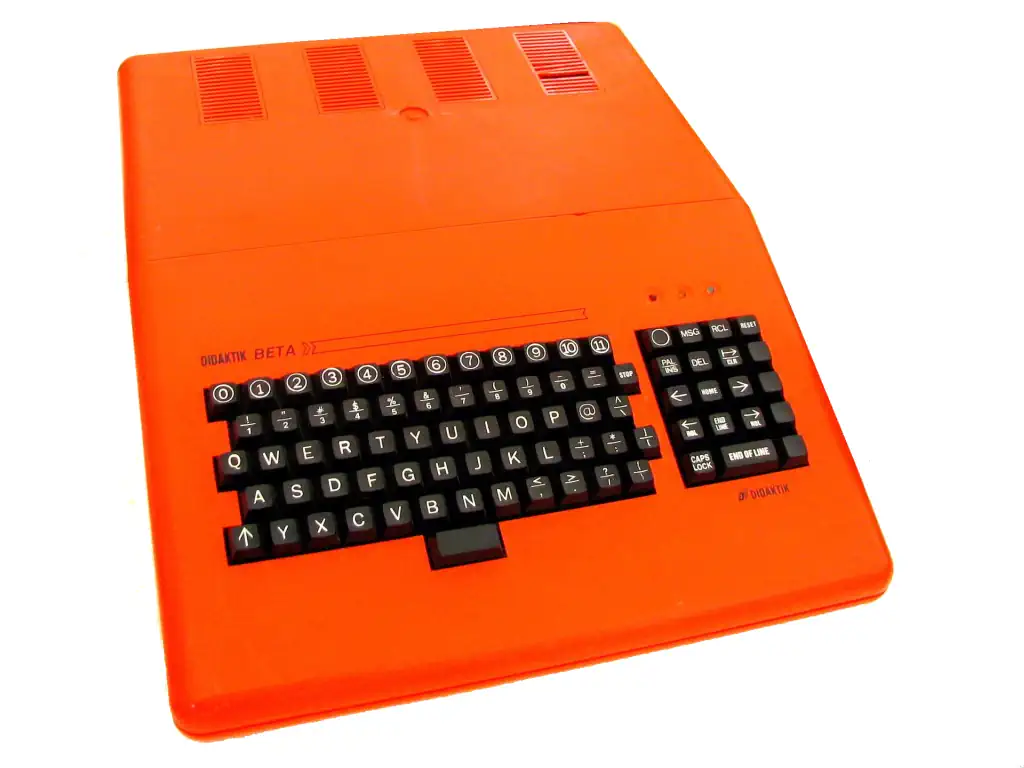

The Didaktik Beta was a slightly improved version of the Didaktik Alpha. The hardware between the two machines was practically identical. The Didaktik Alfa and Beta were mostly deployed in schools to replace older PMD 85 computers. Just like the Alfa, the Beta was mostly compatible with the PMD 85.
Just like the Alfa, the Beta had an Intel 8080 CPU running at 2.048MHz, 48kByte of RAM, 8kByte of ROM for the built in BASIC, and could display a resolution up to 288x256 pixels in 4 different colors. The computer had a monitor video output, but no TV output.
CPU - The Intel 8080
The Intel 8080 was an 8-bit microprocessor that was designed and manufactured by Intel Corporation. It was the first CPU in the x80 series, and was released in April 1974. The 8080 had a clock speed of 2 MHz and was capable of addressing 64 KB of memory. It had a total of 45 instructions and 7 registers, including the Accumulator, the Flags register and the stack pointer.
One of the key features of the 8080 was its ability to directly execute instructions for input/output operations, allowing for more efficient communication with peripheral devices such as keyboard, display, and storage. This made the 8080 a popular choice for early personal computers like the Altair 8800, the IMSAI 8080 and the first IBM PC.
Additionally, the 8080's architecture was widely adopted in industrial control systems and arcade games. It was also used as the basis for other microprocessors such as the Zilog Z80 which was widely used in home computers of the 1980s.
The 8080 was succeeded by the 8085 microprocessor in 1976, which was similar to the 8080 but had an additional instruction set and an integrated clock generator. The 8080 and the 8085 together with their variants and clones played an important role in the development of the microcomputer industry and the personal computer revolution.
ROM: 8kB