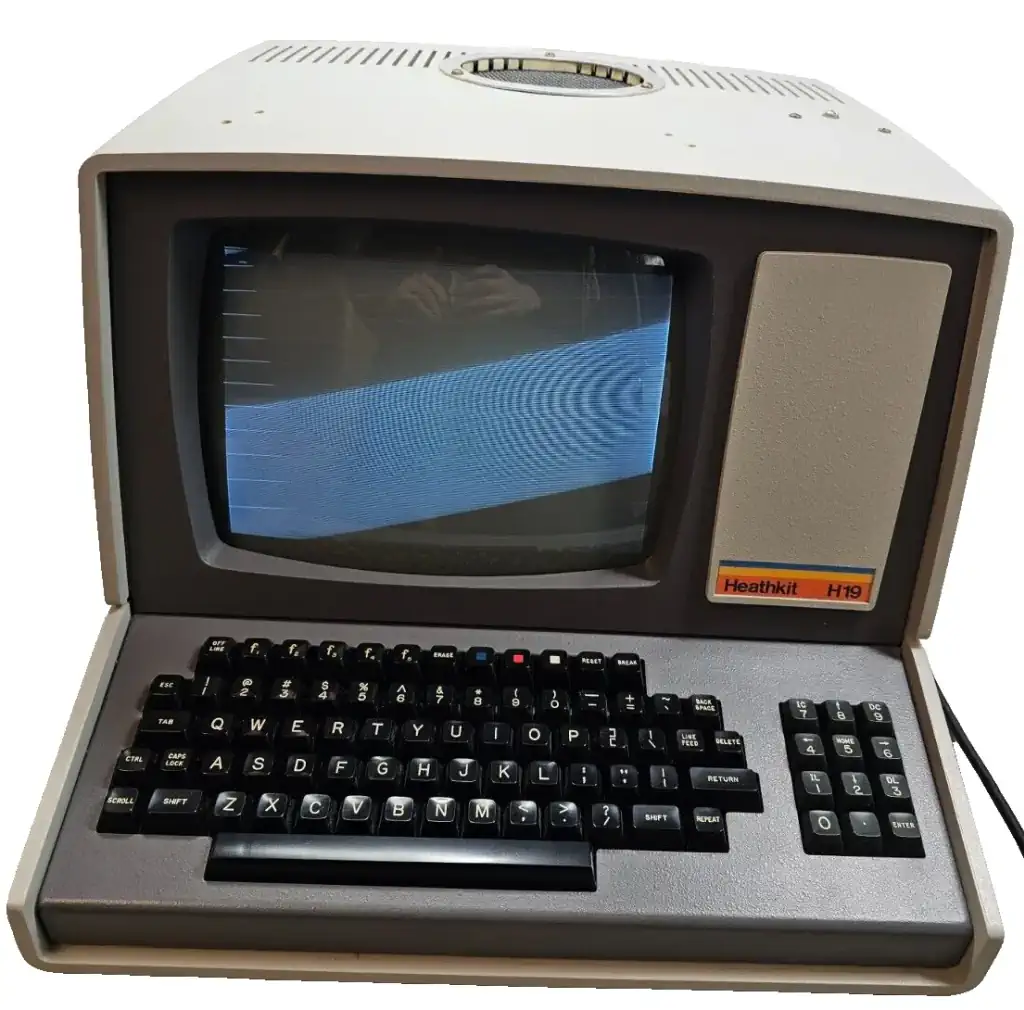

The Heathkit H19
The Heathkit H19, also sold assembled as the Zenith Z-19, is a highly capable video terminal introduced in 1979. It is historically significant not just as a standalone "smart" terminal, but because its chassis and internal design served as the physical foundation for the Zenith Z-89 all-in-one computer. Designed to interface with systems like the Heathkit H8 or other early microcomputers, the H19 provides a professional-grade user interface. Unlike the "dumb" terminals of its era, the H19 possesses its own dedicated onboard processing, making it an intelligent conversational CRT capable of complex local control and data formatting.
The computational brain of the H19 terminal is a dedicated Zilog Z80 microprocessor. Rather than executing user programs, this Z80 is strictly tasked with managing terminal operations, executing firmware stored on 4 KB of onboard ROM. It handles data transmission, keyboard scanning, and screen rendering without relying on the host computer's CPU. The architecture includes a 128-character buffer to hold incoming data, preventing character loss during high-speed transmission. By standardizing on the Z80 for terminal operations, Heathkit ensured rapid handling of escape sequences and terminal control codes, natively supporting both ANSI standards and widespread DEC VT-52 compatibility.
The H19 features a 12-inch, non-glare monochrome CRT display. It renders text in an 80-column by 24-line format, uniquely reserving a 25th line at the bottom of the screen specifically for status information or function key labels, bringing the total display capacity to 2000 characters. The character generator supports a 128-character set, comprising 95 standard ASCII characters and 33 specialized block-graphics symbols. Character rendering utilizes a 5x7 dot matrix for uppercase letters and a 5x9 matrix for lowercase letters, which properly displays true descenders. The graphics symbols utilize an 8x10 matrix, enabling the construction of continuous forms and basic user interface layouts.
Input is handled by an 84-key typewriter-style keyboard, which includes a dedicated 12-key numeric keypad for rapid data entry and direct cursor control. Above the main cluster sits a row of eight specialized function keys that transmit two-character escape sequences, allowing users to customize commands for specific host applications. For communication, the terminal relies on a standard EIA RS-232C asynchronous serial interface. It supports switch-selectable transmission speeds ranging from 110 baud up to 9600 baud in either half- or full-duplex modes, making it adaptable for interfacing with everything from early acoustic couplers to mainframe computers.
CPU - The Zilog Z80
The Z80 quickly became popular in the personal computer market, with many early personal computers, such as the TRS-80 and Sinclair ZX80, using the Z80 as their central processing unit (CPU). It was also widely used in home computers, such as the MSX range, SORD, and the Amstrad CPC, as well as in many arcade games. Additionally, it was also used in other applications such as industrial control systems, and embedded systems. The Z80 was widely used until the mid-1980s, when it was gradually replaced by newer microprocessors such as the Intel 80286 and the Motorola 68000.
The Z80 microprocessor was developed by Zilog, a company founded by Federico Faggin in 1974. The Z80 was released in July 1976, as a successor to the Intel 8080. It was designed to be fully compatible with the 8080, but also included new features such as an improved instruction set, more powerful interrupts, and a more sophisticated memory management system.
Originally the Z80 was intended for use in embedded systems, just as the 8080 CPU. But the combination of compatibility, superior performance to other CPUs of the era, and the affordability led to a widespread use in arcade video game systems, and later in home computers such as the Osborne 1, TRS-80, ColecoVision, ZX Spectrum, MSX, Sega's Master System and many more. The Z-80 ran the original Pac-Man arcade cabinet. The Z-80 was used even in the Game Gear (1990s), and the TI-81 and succeeding graphic calculators.
The Z-80 remained in production until June of 2024, 48 years after its original release. Zilog replaced the processor with its successor the eZ80, an 8-bit microprocessor that features expanded memory addressing up to 16 megabytes, and running up to 50MHz, comparable to a Z80 clocked at 150MHz.

CP/M Operating System
CP/M (Control Program for Microcomputers), created by Gary Kildall in 1974 for Intel 8080-based systems, was the first widely adopted microcomputer operating system to establish a standard software platform. At its core, CP/M was divided into three layers: the BIOS (Basic Input/Output System) for hardware-dependent routines, the BDOS (Basic Disk Operating System) for file and device abstractions, and the CCP (Console Command Processor) for the command-line interface. This modular design meant CP/M could be ported to a wide variety of 8-bit systems simply by rewriting the BIOS layer, while the BDOS and CCP remained binary-compatible. This allowed application developers to target a single OS API rather than custom hardware interfaces, which was a radical departure from the fragmented landscape of early microcomputers.
Memory management in CP/M was constrained by the 8080 and Z80’s 64 KB address space, so the operating system was designed to occupy only the top portion of memory. The BDOS and CCP were typically loaded into high memory, leaving a contiguous block of low memory available for transient programs (user applications). Applications were written to expect a fixed TPA (Transient Program Area), with the starting address varying slightly depending on how much memory was available after BIOS/BDOS were loaded. This simple scheme avoided the need for virtual memory or sophisticated protection mechanisms, but it limited multitasking: CP/M was strictly a single-tasking environment. Program overlays and clever memory swapping techniques were sometimes used by developers to fit larger applications into the available TPA, especially for compilers and database software.
Application support was the main driver of CP/M’s dominance. Its standardization around the BDOS interface meant that word processors, assemblers, compilers (notably for C, Pascal, and BASIC), and business applications could run on hundreds of different hardware platforms with minimal modification. Programs were distributed as .COM files—binary images loaded directly into the TPA without relocation—which simplified the loader at the cost of flexibility. Libraries like Digital Research’s PL/I subset and third-party toolchains extended CP/M into a development platform, while the vast ecosystem of utilities (from editors like ED to debuggers and communications software) established it as the de facto operating system of the late 1970s and early 1980s microcomputing world. For retrocomputing enthusiasts, CP/M represents the moment when software compatibility, not just hardware, became the central value in the microcomputer marketplace.
RAM max: 48kB
HDOS
CP/M
MP/M