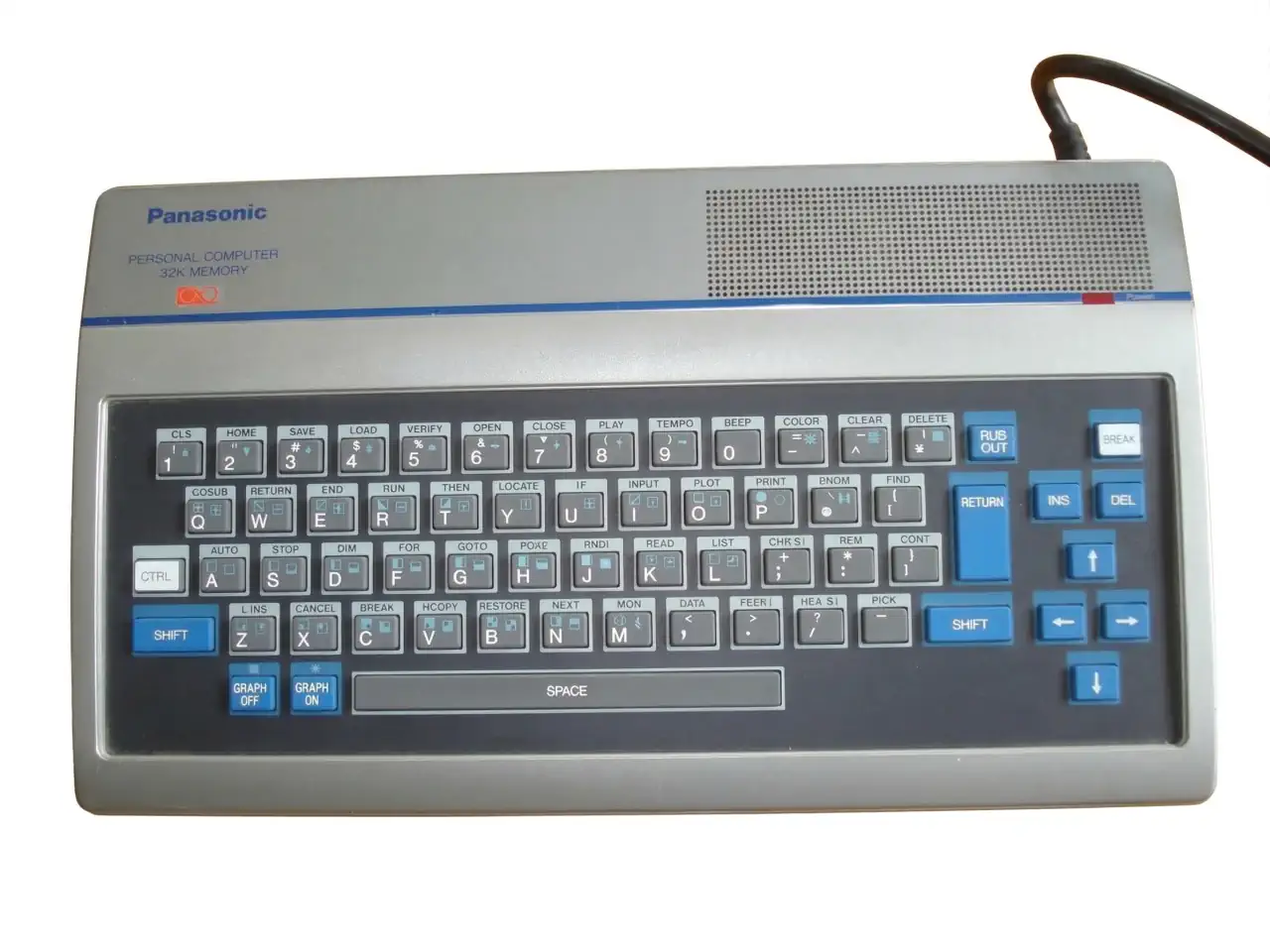

The Panasonic JR-200
The Panasonic JR-200, released in late 1982, represented a significant evolution over the JR-100, transitioning from a bare-bones hobbyist machine to a more capable home computer. While it retained a similar chiclet-style rubber keyboard, the JR-200 featured a much more professional silver and black aesthetic and a sturdier build. Most importantly, it moved away from the extreme minimalism of its predecessor, offering vastly expanded memory and connectivity, including built-in joystick ports, a printer port, and even support for a floppy disk drive, positioning it as a direct competitor to the Commodore 64 and VIC-20.
Under the hood, the JR-200 was powered by the MN1800A CPU, a Panasonic-made microprocessor compatible with the Motorola 6802, running at roughly 0.89 MHz While the CPU architecture was similar to the JR-100, the JR-200’s memory was doubled to 32 KB of RAM (expandable to 40 KB), providing significantly more room for complex BASIC programs and data. To handle the increased complexity of its I/O and keyboard management, it added a secondary 4-bit MN1544 co-processor, offloading those tasks from the main CPU to ensure smoother performance. The graphics capabilities saw the most dramatic upgrade, moving from the strictly monochrome display of the JR-100 to a vibrant 8-color system While it still utilized a character-based architecture (32 columns by 24 lines), it introduced a much richer character set of 253 built-in symbols, including Katakana and Greek letters. By utilizing its 256 user-definable characters programmers could achieve a high-resolution bitmapped effect of 256 x 192 pixels a massive leap from the blocky pseudo-graphics of the earlier model. It also included a "low-resolution" mode of 64 x 48 blocks that could be colored independently. Audio also received a major overhaul via the MN1271 I/O and timer chip. Unlike the JR-100’s single-channel beeper, the JR-200 was capable of three-voice polyphony producing square-wave tones across five octaves. This allowed for actual music synthesis, supported by dedicated BASIC commands like `PLAY` and `TEMPO` which could even run in the "background" while a program continued to execute. With its internal speaker and a volume knob on the back, the JR-200 was a much more formidable multimedia machine than its humble predecessor.Sound and Keyboard
The MN1544CJR is a 4-bit microcontroller (from the Panasonic MN1500 series) used as a dedicated I/O processor. Its primary job is to handle the keyboard scanning and the joystick ports. This frees up the main CPU to focus on executing software.
The audio generation is handled by the MN1271 (sometimes labeled as a latch or an I/O expander). Here is how the labor is divided:
- MN1544 (The Manager): Scans the keyboard matrix and reads the status of the joystick triggers. It communicates this data back to the main CPU.
- MN1271 (The Performer): This chip contains the programmable timers used for sound. When you use a PLAY command in BASIC, the system sends frequency data to the MN1271, which then toggles the output at that specific frequency to create square-wave tones.
The JR-200 Sound Architecture
The MN1271 is responsible for the JR-200's signature 3-voice polyphony. It manages three separate channels that are mixed together before being sent to the internal speaker. This was a massive step up from the JR-100, which essentially just "toggled" a single bit on a simple flip-flop to make noise.Because the MN1271 is essentially a timer-based chip, the "music" it produces is very clean but limited to "beeps and boops" (square waves), lacking the complex filters or envelope control found in something like the Commodore 64’s SID chip.
The 8-bit CMOS MN1800A processor
The MN1800A is an 8-bit CMOS microprocessor manufactured by Panasonic (then Matsushita) in the early 1980s.
It is most famous for being a "clone" or highly compatible variant of the Motorola 6802 (which was itself an improved version of the legendary Motorola 6800). If you are familiar with the 6800 family of processors—which powered early industrial equipment and computers like the Altair 680—you’ll find the MN1800A very similar in architecture.
Key Technical Specifications
The MN1800A was designed for home computers and embedded control systems. Here is a breakdown of its core characteristics:
- Word Size: 8-bit data bus.
- Address Space: 16-bit address bus (capable of addressing up to 64 KB of memory).
- Clock Speed:Typically ran around 0.89 MHz to 1 MHz (though the "A" variant could technically handle up to 1.5 MHz).
- Instruction Set: Compatible with the Motorola 6802. It includes 72 instructions with various addressing modes.
- Internal Registers:
- Two 8-bit Accumulators (A and B): Used for arithmetic and logic operations.
- 16-bit Index Register (X): Used for memory addressing.
- 16-bit Stack Pointer (S) and Program Counter (PC).
The most prominent use of the MN1800A was as the main CPU for the Panasonic (National) JR-200 home computer released in 1982.
Interestingly, in that system, the MN1800A didn't work alone. It was paired with a secondary 4-bit processor (the MN1544CJR) that handled input/output (I/O) tasks like managing the keyboard and generating sound. This "dual-processor" setup allowed the MN1800A to focus more on running programs and processing logic.
Comparison: MN1800A vs. Motorola 6802
While they are functionally almost identical, there is one major hardware difference:- Motorola 6802: Has an internal clock oscillator.
- Panasonic MN1800A: Does not have an internal oscillator; it requires an external clock signal to be provided to the chip.
VRAM: 2kB
2kB for graphic characters
2kB VRAM
64x48 semi graphics (256x192 virtual graphics)