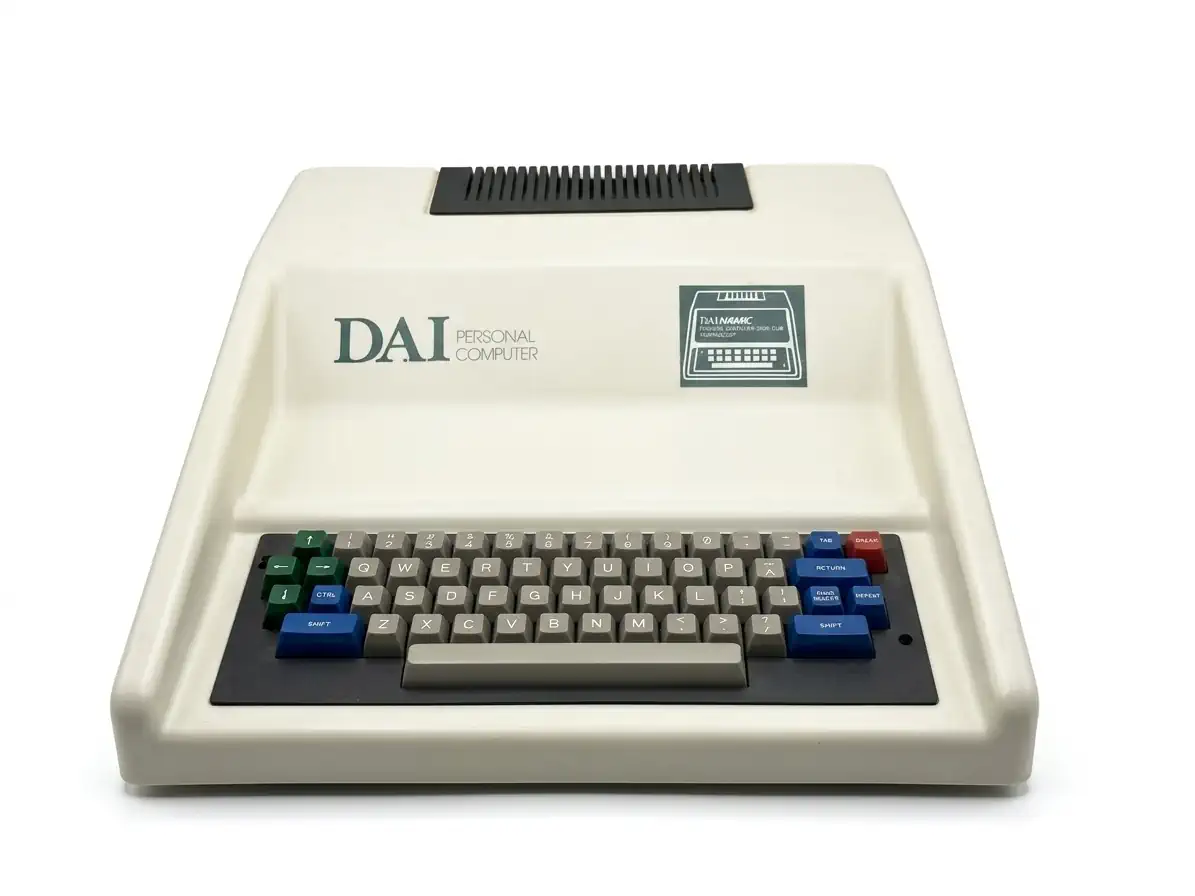

The DAI Personal Computer.
The DAI personal computer is a home computer produced by the Belgian company Data Applications International. The DAI was released in 1980 and had features such as high resolution graphics, a math co-processor and a BASIC interpreter that pre-compiled programs before execution.
the DAI Personal Computer was initially conceived to fulfill Texas Instruments' requirement for a PAL-compatible system in the European market. Housed in a distinct white enclosure featuring an integrated 56-key ASCII keyboard, the system architecture is centered on the 8-bit Intel 8080A microprocessor clocked at 2 MHz. While the 8080A was an older design compared to contemporary Z80 implementations, the DAI compensates by including a dedicated motherboard socket for an optional AMD 9511 hardware math co-processor. When installed, this chip handles complex mathematical functions in hardware, dramatically increasing execution speeds for floating-point calculations. The core logic is contained entirely on a single printed circuit board utilizing approximately 120 individual integrated circuits.
The memory architecture of the DAI supports a maximum of 48 KB of dynamic RAM and 24 KB of ROM, supplemented by 256 bytes of static RAM strictly reserved for CPU stack operations. The system utilizes memory map bank switching across three 16 KB regions, theoretically allowing up to 72 KB to be addressable by the processor. Graphics output is driven by a Thomson EF9369 controller paired with a proprietary Programmable Graphics Generator. This hardware configuration allows for highly flexible display modes, topping out at a very high resolution of 528 x 240 pixels. The color palette supports either 4 or 16 colors, managed through indexed color techniques to conserve the main system RAM. For audio, the DAI incorporates a General Instrument AY-3-8910 chip, delivering three programmable frequency generators and one noise generator, notably capable of outputting full stereo sound.
Program storage relied on two integrated audio-cassette interfaces operating at 600 baud, featuring built-in motor control for automated data retrieval and saving. For more demanding applications, the storage subsystem could be expanded via the optional DAI Real World Card System rack to support dual 5.25-inch floppy disk drives. These drives provide 180 KB of formatted capacity each and enable full compatibility with the CP/M operating system. System connectivity is highly expansive, featuring a standard RS-232C serial port, two DIN interfaces for paddle controllers, and the proprietary DCE-Bus. The DCE-Bus is a 36-pin parallel interface that provides three separate 8-bit I/O lines, engineered specifically to connect the DAI directly to laboratory, testing, and industrial control peripherals.
CPU - The AY-3-8610
The AY-3-8610 "Ball & Paddle" chip was a major upgrade from General Instruments. It played more games than it's predecessor with higher quality graphics. The chip was named "Superstar" by the team at General Instruments. The chip itself displayed games in black and white, but by adding the AY-3-8615 companion chip, games could be output in color.
The AY-3-8610 contained ten built in games:
- Tennis/Pong
- Soccer/Hockey
- Squash
- Practice game
- Gridball
- Handball
- Basketball
- Basketball Practice
- Two player target
- Single Player target
The AY-3-8610 had a completely different pinout from the 8500 and in addition, it needed an external crystal oscillator. The synchronization pin was removed, but it retained two separate video out pins.
Thomson EF936x Graphics Display Processor
The Thomson EF936x is a type of Graphic Display Processor (GDP) manufactured by Thomson-EFCIS. It was designed between 1976 to 1978 by Philippe Matherat who was a student at the time at the Ecole Normale Superieure in Paris. The chip could draw at a speed of 1 million pixels per second which was advanced for the time. The chip has various different versions with slightly different capabilities.
Versions of the EF936x
- EF9364 CRT Processor introduced in 1977
- EF9365 Added new resolutions: 512x512 (interlaced), 256x256, 128x128, 64x64
- EF9366 Added 512x256 non-interlaced resolution
- EF9367 Added 1024x512 interlaced, 1024x416 interlaced resolutions
The Chip had an integrated DRAM controller, was capable of line drawing with delta-x and delta-y limited to 255 each. It also supported solid, dotted, dashed, and dotted/dashed lines.
The GDP supported a 5x8 pixel ASCII font and supported tilted characters and integer scaling of the characters. Lastly, the chip had a clear screen command and support for a light-pen.
CPU - The Intel 8080
The Intel 8080 was an 8-bit microprocessor that was designed and manufactured by Intel Corporation. It was the first CPU in the x80 series, and was released in April 1974. The 8080 had a clock speed of 2 MHz and was capable of addressing 64 KB of memory. It had a total of 45 instructions and 7 registers, including the Accumulator, the Flags register and the stack pointer.
One of the key features of the 8080 was its ability to directly execute instructions for input/output operations, allowing for more efficient communication with peripheral devices such as keyboard, display, and storage. This made the 8080 a popular choice for early personal computers like the Altair 8800, the IMSAI 8080 and the first IBM PC.
Additionally, the 8080's architecture was widely adopted in industrial control systems and arcade games. It was also used as the basis for other microprocessors such as the Zilog Z80 which was widely used in home computers of the 1980s.
The 8080 was succeeded by the 8085 microprocessor in 1976, which was similar to the 8080 but had an additional instruction set and an integrated clock generator. The 8080 and the 8085 together with their variants and clones played an important role in the development of the microcomputer industry and the personal computer revolution.
RAM max: 48kB
176x130
352x260
528x240