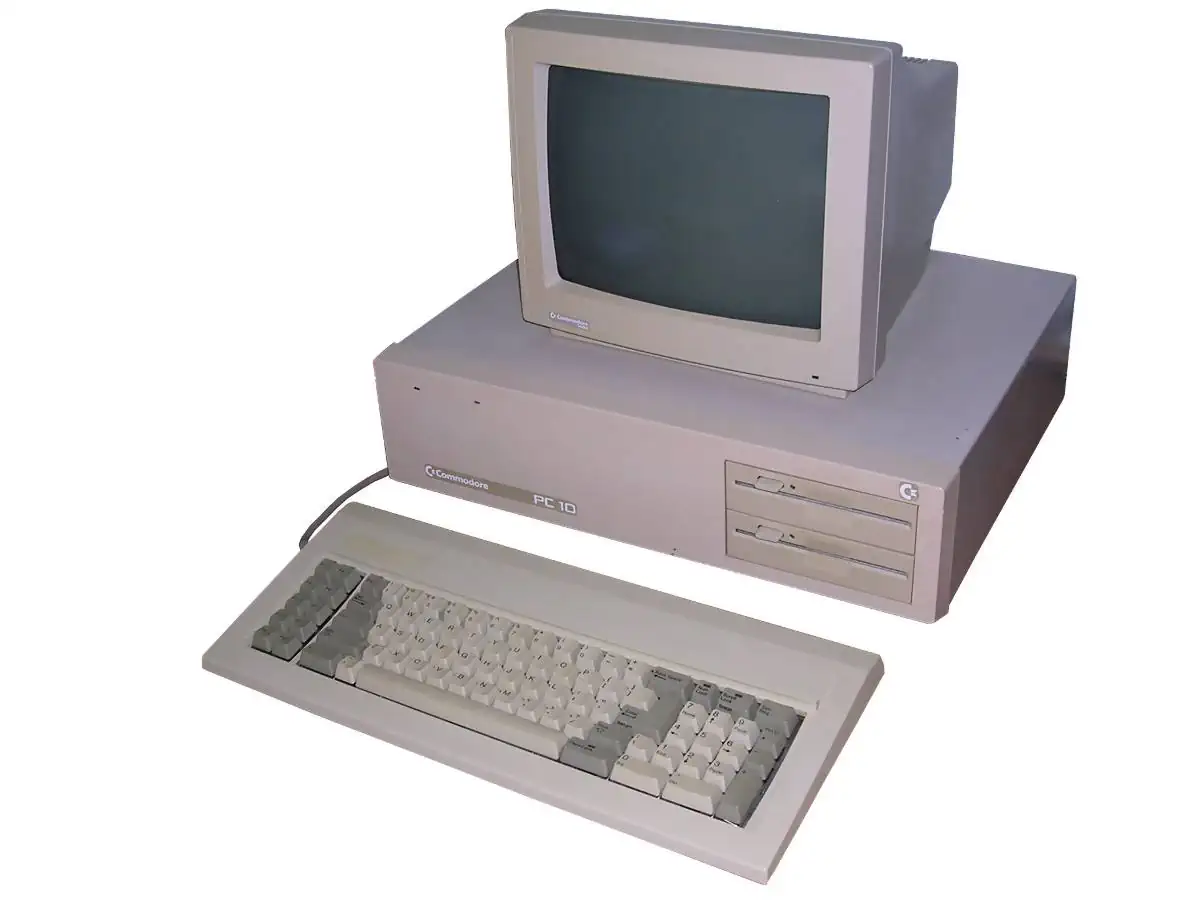

The Commodore PC-10 is an IBM PC-XT clone. It was the same machine as the PC-5, but with an added color ATI video card that was capable of MDA text, CGA color graphics, and high resolution Hercules monochrome graphics. The machine came with two 5.25" floppy disk drives.
The PC-10 had an Intel 8088 as its CPU running at 4.77MHz. The computer only came with 256kByte of RAM, but this was expandable to 640kByte. The PC-10, just like the PC-5, had 4 8-bit PC BUS Slots. The computer has two motherboards. One contains the CPU, RAM and ROM, and the second motherboard is the I/O board, containing serial and parallel port, ISA slots, and all other I/O chips.
MS-DOS Operating System
MS-DOS (Microsoft Disk Operating System) originated in 1981 when Microsoft acquired QDOS (Quick and Dirty Operating System) from Seattle Computer Products and adapted it for IBM’s upcoming 8088-based personal computer. Initially branded as IBM PC-DOS 1.0 for IBM, and MS-DOS for other vendors, it provided a single-user, single-tasking environment that was heavily inspired by CP/M. The system was structured around a kernel (IBMBIO.COM and IBMDOS.COM in PC-DOS, IO.SYS and MSDOS.SYS in MS-DOS) that interfaced with hardware and implemented system services, plus a command interpreter (COMMAND.COM) that offered a user interface and executed batch files. Early versions supported only 160 KB or 320 KB floppy disks, a flat directory structure, and a very limited system call API.
Technically, MS-DOS was designed around the Intel 8086/8088’s segmented memory model, giving programs access to up to 640 KB of conventional memory, with the upper memory area reserved for system BIOS and hardware. The OS itself was not re-entrant and offered no process isolation: a single foreground program owned the machine at any given time, and the kernel simply provided file and device I/O calls. Devices were abstracted as special files (CON, PRN, AUX, NUL), allowing consistent access via the same system calls used for disk files. Its filesystem, FAT12, offered a simple, space-efficient design suitable for floppy media but imposed limits such as 8.3 filenames and small maximum volume sizes.
As the IBM PC platform expanded, MS-DOS evolved rapidly. Version 2.0 (1983), designed for the IBM XT with a hard drive, introduced FAT16, hierarchical subdirectories, file handles, and device drivers that could be dynamically loaded. Later releases added support for larger disks, expanded memory (via EMS/XMS standards), internationalization, and more sophisticated batch scripting. Version 3.x aligned with the IBM AT and its 80286 CPU, supporting 1.2 MB floppies, larger hard disks, and network redirectors. By version 4.0, MS-DOS began showing signs of strain under the growing complexity of PC hardware, and memory management became a recurring challenge due to the 640 KB conventional memory limit and the awkward use of extended and expanded memory schemes.
Despite being inherently single-tasking, MS-DOS was extended through third-party multitasking shells and Microsoft’s own attempts such as MS-DOS 4.0 Multitasking (rarely used). Eventually, MS-DOS served as the underlying runtime for Windows 3.x, which leveraged DOS for file and device I/O but implemented a cooperative multitasking GUI environment on top. With the release of Windows 95 and later, MS-DOS was gradually absorbed into Windows as a bootstrapping layer and compatibility subsystem. Nonetheless, MS-DOS’s simple architecture, reliance on BIOS and device drivers, and its widespread adoption made it the de facto standard for microcomputer operating systems throughout the 1980s, shaping software design and hardware standards for years to come.
CPU - The Intel 8088
The Intel 8088 microprocessor is a variant of the Intel 8086. The 8088 has an 8-bit external bus instead of the 16-bit bus that the 8086 has. The 16-bit registers and the 1MByte address range are unchanged, however. The 8086 and the 8088 have the same execution unit (EU), only the Bus Interface Unit (BIU) differs.
The original IBM PC architecture is based on the Intel 8088. The CPU runs at 5 to 16 MHz, has a 20-bit address bus and can work together with the 8087 Co-Processor. The 8088 was launched in 1979. The 8088 is compatible with the Intel 8085.
RAM max: 640kB
MDA & Hercules Graphics Modes