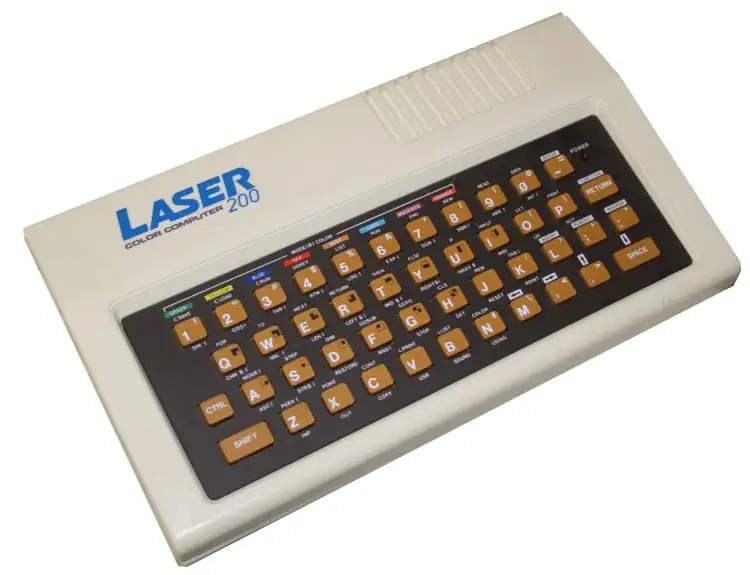

VTech Laser 200
The VTech Laser 200 is an 8-bit home computer released in 1983 by Video Technology or VTech. The computer is also sold as the Salora Fellow in Finland, the Seltron 200 in Hungary and Italy, the Smart-Alec Jr. in the USA, the Texet TX8000A in the UK, the Dick Smith VZ 200 in Australia and New Zealand, and the VTech VZ 200 in the USA and Canada.
When the VZ200 was released in the USA, it quickly had competition from the Timex TS1000, which sold for only $30. In other countries, where Timex did not have a strong foothold, the VZ200 did better. The most popular was the version sold in Australia and New Zealand. In those countries, the computer was bought primarily by people to learn how to program in BASIC. The BASIC was more capable than the Commodore 64 basic, even though that machine was overall more powerful. In the UK the machine fared poorly against the ZX Spectrum, even though it sold for less than the spectrum, the VZ200 had little impact on the market.
The VZ200 internally contains three circuit boards, one for the power supply, one for the video circuit, and then the main board. The architecture is similar to the Tandy TRS-80, but due to different memory mapping, the software is incompatible, and only simple TRS-80 BASIC programs can be run without problems.
The VZ200 uses a NEC version of the Z80 and was released initially with only 4kB of memory. Within a few weeks of its release this was increased to 8kByte to make the machine more attractive. A 16kByte expansion unit was available, so that the computer could have a total of 24kByte of RAM available to it. For the hobbyist with some soldering skills, the video RAM could be expanded as well, since there were video RAM chip select lines available on the memory expansion unit.
Laser Video Capabilities
For its video capabilities, The VZ200 uses the Motorola 6847 Video Processor, which has a maximum resolution of 256x192 pixels made up from 8x8 pixel character blocks. With the installed 2kByte of VRAM, the bitmapped mode was unavailable, and the text mode could provide a semi-resolution of only 256x128 pixels. The VZ200 has 256 predefined character blocks and a total of nine colors, consisting of eight colors plus black. The character blocks are stored in ROM and cannot be redefined.
Text MODE 0
In mode 0, the background color can be dark green or orange, with black text. The first 128-character blocks are 64 alpha-numeric characters and their inverse. Mode 0 is the only mode in which black is available. The second 128-character blocks consist of 2x2 pixel blocks in various combinations for every of the 8 colors available. This made crude semi-graphics possible.Text MODE 1
In mode 1, two color schemes are used with each background.- Color Scheme 1 background: light green, foreground: light green, yellow, blue or red.
- Color Scheme 2 background: white, foreground: white, cyan, magenta or orange.
Graphics Mode
The graphics mode has 128×64 semi-pixels. For each character block, the background color can be white or light green and the foreground color can be any in the chosen color scheme, only one color set can be used at a time, so only four colors can be displayed simultanously. Some clever users figured out that with precise video timing using assembly code, it is possible to split the display to show all eight colors on the screen, you can find these techniques shown in the VZ200 Five Finger Punch demo '2018AD' and Bushy555's demo '8 colors'.Video - Motorola MC6847 VDG
The Motorola MC6847 is a versatile Video Display Generator (VDG) introduced in 1978, designed to interface between microprocessors and television circuitry. It was a staple of early 8-bit computing, most notably powering the TRS-80 Color Computer and the Dragon 32/64 The chip is capable of generating both alphanumeric text and bitmapped graphics in several distinct modes, utilizing an internal ROM for character generation or external RAM for high-resolution graphics. It outputs a composite video signal in NTSC format, though variants like the MC6847Y and MC6847P were used for different clocking and signal requirements.
Hardware Interface and Signal Logic
The MC6847 operates on a 3.579545 MHz clock—the standard NTSC colorburst frequency—which it uses to derive all internal timing for horizontal and vertical synchronization. It features an 8-bit data bus and a series of mode-select pins (GM0, GM1, GM2, S/A, Int/Ext, CSS that determine the display format. Because the VDG and the CPU (often the MC6809) must share access to the same bank of video RAM, the chip provides a Device Busy (DB) signal or works in tandem with a synchronous address multiplexer (like the MC6883 SAM) to prevent "snow" or bus contention during the active display cycle.
Alphanumeric and Semigraphics Modes
In its base Alphanumeric mode, the MC6847 displays a 32x16 grid of characters. It features an internal character generator ROM that produces a limited 5x7 pixel font within an 8x12 pixel block. A unique feature of this chip is its Semigraphics modes (SG4, SG6, SG8, SG12, etc.), which divide each character block into smaller "pixels" or sub-blocks. For instance, Semigraphics 4 divides a block into a 2x2 matrix, allowing for a pseudo-graphics resolution of 64x32 while still treating the data as ASCII-like character bytes, which significantly reduces the memory overhead for the host system.
High-Resolution Graphics and Color Palette
The chip’s true bitmapped graphics modes, referred to as "Full Graphics," range from Resolution Graphics One (RG1) at 64x64 pixels to High-Resolution Graphics Six (RG6) at 256x192 pixels. At its highest resolution, the MC6847 is limited to a monochrome (two-color) display due to the 6KB memory ceiling of the addressing scheme. In lower-resolution modes, such as 128x192, it supports a four-color palette. The color selection is governed by the Color Set Select (CSS) pin, which toggles between two hardware-defined palettes:
- Palette 0: Green, Yellow, Blue, Red.
- Palette 1: Buff (White), Cyan, Magenta, Orange.
Memory Addressing and Video Synthesis
The MC6847 does not have internal RAM; instead, it generates a 13-bit address bus (DA0–DA12 to fetch data from external memory. As the electron beam scans the television screen, the VDG continuously cycles through the memory locations, converting the retrieved bytes into a serial bitstream. This stream is then processed by the internal luminance (Y) and chrominance (phi-A, phi-B) modulators. Because the chip was designed for cost-effective home electronics, it handles the complex task of NTSC color encoding internally, requiring only a minimal external buffer and an RF modulator to produce a signal a standard television can interpret.
CPU - The Zilog Z80
The Z80 quickly became popular in the personal computer market, with many early personal computers, such as the TRS-80 and Sinclair ZX80, using the Z80 as their central processing unit (CPU). It was also widely used in home computers, such as the MSX range, SORD, and the Amstrad CPC, as well as in many arcade games. Additionally, it was also used in other applications such as industrial control systems, and embedded systems. The Z80 was widely used until the mid-1980s, when it was gradually replaced by newer microprocessors such as the Intel 80286 and the Motorola 68000.
The Z80 microprocessor was developed by Zilog, a company founded by Federico Faggin in 1974. The Z80 was released in July 1976, as a successor to the Intel 8080. It was designed to be fully compatible with the 8080, but also included new features such as an improved instruction set, more powerful interrupts, and a more sophisticated memory management system.
Originally the Z80 was intended for use in embedded systems, just as the 8080 CPU. But the combination of compatibility, superior performance to other CPUs of the era, and the affordability led to a widespread use in arcade video game systems, and later in home computers such as the Osborne 1, TRS-80, ColecoVision, ZX Spectrum, MSX, Sega's Master System and many more. The Z-80 ran the original Pac-Man arcade cabinet. The Z-80 was used even in the Game Gear (1990s), and the TI-81 and succeeding graphic calculators.
The Z-80 remained in production until June of 2024, 48 years after its original release. Zilog replaced the processor with its successor the eZ80, an 8-bit microprocessor that features expanded memory addressing up to 16 megabytes, and running up to 50MHz, comparable to a Z80 clocked at 150MHz.

RAM max: 2kB
ROM: 16kB
VRAM: 24kB
128x64 graphics in 2 BG and 3 FG colors
Disk Drive