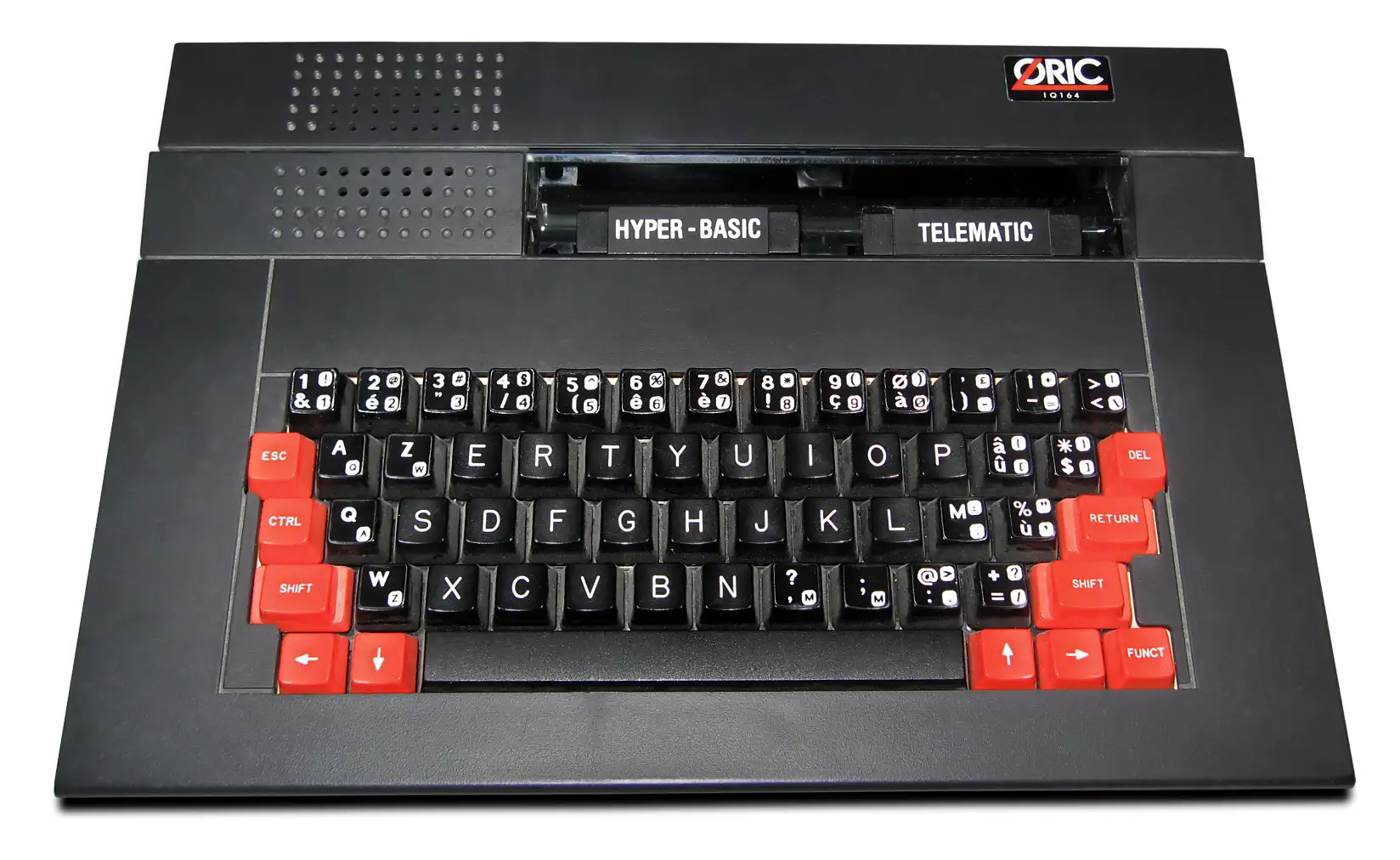

Oric Telestrat
The Telestrat is a telecommunications-oriented machine. It comes with a disk drive as standard, and only connects to an RGB monitor / TV. The machine is backward compatible with the Oric-1 and Oric Atmos by using a cartridge. Most of the software is in French, including Hyper-BASIC's error messages. Up to 6000 units were sold in France.
Although the Oric Atmos had not turned around Oric International's fortunes, in February 1985, they announced several models including the Oric Stratos/IQ164. Despite their backers putting them into receivership the following day, Oric was bought by French company Eureka, which continued to produce the Stratos, followed by the Oric Telestrat in late 1986.
The Stratos and Telestrat increased the RAM to 64 KB and added more ports, but kept the same processor and graphics and sound hardware as the Oric-1 and Atmos.
Sound - The AY-3-8910 PSG
The AY-3-8910 is a 3-voice Programmable Sound Generator, or PSG. It was designed by General Instruments in 1978 for use with their own 8-bit PIC1650 and their 16-bit CP1610 computers.
The PSG is widely used in many arcade cabinets, pinball machines, and many micro-computers. Here is a list of some of the major brands of computer that used the AY-3-8910:
- Intellivision
- Vectrex
- Amstrad CPC range
- Oric-1
- Color Genie
- Elektor TV Games Computer
- All MSX-1 and MSX-2 computers
- ZX Spectrum home computers
General Instrument spun of MicroChip Technology in 1987 and the chip was sold under the MicroChip brand, and licensed to Yamaha as the YM2149F which the Atari ST range of computers use. Functionally the PSG is very similar to the Texas Instruments SN76489.
Variants:
-
AY-3-8910
Comes with 2 general purpose 8-bit parallel I/O ports, used for Keyboard and Joystick in for instance MSX. -
AY-3-8912
Same chip, but in a 28-pin package. Parallel port B is not connected to save cost and space. -
AY-3-8913
Same chip, but in a 24-pin package. Both parallel ports are not connected. -
AY-3-8914
The AY-3-8914 has the same pinout and is in the same 40-pin package as the AY-3-8910, except the control registers on the chip are shuffled around, and the 'expected input' on the A9 pin may be different. It was used in Mattel's Intellivision console and Aquarius computer. -
AY-3-8930
Backwards compatible but BC2 pin is ignored
YM2149F -
YM3439-D
CMOS version of the Y2149 in 40-pin DIP -
YM3439-F
CMOS version of the Y2149 in 44-pin QFP -
YMZ294
Variant of the YM3249 in an 18-pin package. Parallel ports not connected, and all sound channels mixed on 1 port. -
T7766A
Toshiba variant of the AY-3-8910, fully compatible. Used in some MSX models. - Winbond WF19054, JFC95101, and File KC89C72: Fully compatible versions of the AY-3-8910 produced for slot machines.
Yamaha Produced chip, same pin-out as the AY-3-8910, but pin 26 could halve the master clock. Can be used to replace the AY-3-8910 if pin 26 is left disconnected.
CPU - The Motorola 6502
The 6502 is an 8-bit MicroProcessor designed by MOS Technology. The team was led by Chuck Peddle and had also worked on the Motorola 6800. The 6502 is a simplified, but faster and cheaper design than the 6800.
The 6502 was introduced in 1975 and was the cheapest microprocessor on the market. Together with the Zilog Z80, the 6502 helped start the home computer revolution of the 1980s. The 6502 was used in a wide range of devices: the Atari 2600, the 8-bit Atari home computers, the Apple II, the Nintendo Entertainment System, the Commodore 64, the BBC Micro and many others. All used the 6502 or a variation of it.
The 6502 is a 1MHz design, while the 6502A is designed for 2MHz. The 6502A is 100% compatible with the original 6502.
Commodore soon bought MOS Technology, but conitnued to sell the microprocessor to competitors and licensed the design to other manufacturers.
Source: WikiPedia - MOS Technology 6502The 650x Instruction Set
| Mnemonic | Operation | Description |
|---|---|---|
| ADC | Add with Carry | Adds a memory location and the carry bit to the accumulator. |
| AND | Logical AND | Performs a logical AND between memory and the accumulator. |
| ASL | Arithmetic Shift Left | Shifts all bits one position to the left (in memory or accumulator). |
| BCC | Branch on Carry Clear | Branches to a new address if the carry flag is clear (0). |
| BCS | Branch on Carry Set | Branches to a new address if the carry flag is set (1). |
| BEQ | Branch on Equal (Zero Set) | Branches to a new address if the zero flag is set (1). |
| BIT | Bit Test | Tests bits in memory with the accumulator without modifying the accumulator. |
| BMI | Branch on Minus | Branches to a new address if the negative flag is set (1). |
| BNE | Branch on Not Equal | Branches to a new address if the zero flag is clear (0). |
| BPL | Branch on Plus | Branches to a new address if the negative flag is clear (0). |
| BRK | Force Break | Forces an interrupt request and pushes status and PC to the stack. |
| BVC | Branch on Overflow Clear | Branches to a new address if the overflow flag is clear (0). |
| BVS | Branch on Overflow Set | Branches to a new address if the overflow flag is set (1). |
| CLC | Clear Carry Flag | Clears the processor carry flag. |
| CLD | Clear Decimal Mode | Clears the processor decimal mode flag. |
| CLI | Clear Interrupt Disable | Clears the interrupt disable flag, allowing maskable interrupts. |
| CLV | Clear Overflow Flag | Clears the processor overflow flag. |
| CMP | Compare Accumulator | Compares the contents of a memory location with the accumulator. |
| CPX | Compare X Register | Compares the contents of a memory location with the X register. |
| CPY | Compare Y Register | Compares the contents of a memory location with the Y register. |
| DEC | Decrement Memory | Subtracts one from the value held at a specified memory location. |
| DEX | Decrement X Register | Subtracts one from the X register. |
| DEY | Decrement Y Register | Subtracts one from the Y register. |
| EOR | Exclusive OR | Performs a logical Exclusive OR between memory and the accumulator. |
| INC | Increment Memory | Adds one to the value held at a specified memory location. |
| INX | Increment X Register | Adds one to the X register. |
| INY | Increment Y Register | Adds one to the Y register. |
| JMP | Jump | Sets the program counter to a new address. |
| JSR | Jump to Subroutine | Pushes the return address to the stack and jumps to a new address. |
| LDA | Load Accumulator | Loads a byte of memory into the accumulator. |
| LDX | Load X Register | Loads a byte of memory into the X register. |
| LDY | Load Y Register | Loads a byte of memory into the Y register. |
| LSR | Logical Shift Right | Shifts all bits one position to the right (in memory or accumulator). |
| NOP | No Operation | Performs no operation, consuming 2 machine cycles. |
| ORA | Logical Inclusive OR | Performs a logical OR between memory and the accumulator. |
| PHA | Push Accumulator | Pushes a copy of the accumulator onto the stack. |
| PHP | Push Processor Status | Pushes a copy of the status flags onto the stack. |
| PLA | Pull Accumulator | Pulls a byte from the stack into the accumulator. |
| PLP | Pull Processor Status | Pulls a byte from the stack into the processor status flags. |
| ROL | Rotate Left | Rotates all bits one position left through the carry flag. |
| ROR | Rotate Right | Rotates all bits one position right through the carry flag. |
| RTI | Return from Interrupt | Pulls the processor flags and program counter from the stack. |
| RTS | Return from Subroutine | Pulls the program counter from the stack and resumes execution. |
| SBC | Subtract with Carry | Subtracts memory and the inverse of the carry bit from the accumulator. |
| SEC | Set Carry Flag | Sets the processor carry flag. |
| SED | Set Decimal Flag | Sets the processor decimal mode flag. |
| SEI | Set Interrupt Disable | Sets the interrupt disable flag, preventing maskable interrupts. |
| STA | Store Accumulator | Stores the contents of the accumulator in memory. |
| STX | Store X Register | Stores the contents of the X register in memory. |
| STY | Store Y Register | Stores the contents of the Y register in memory. |
| TAX | Transfer Accumulator to X | Copies the current value of the accumulator into the X register. |
| TAY | Transfer Accumulator to Y | Copies the current value of the accumulator into the Y register. |
| TSX | Transfer Stack Pointer to X | Copies the current value of the stack pointer into the X register. |
| TXA | Transfer X to Accumulator | Copies the current value of the X register into the accumulator. |
| TXS | Transfer X to Stack Pointer | Copies the current value of the X register into the stack pointer. |
| TYA | Transfer Y to Accumulator | Copies the current value of the Y register into the accumulator. |
1 noise
240x200 + 3 text lines
2 colors per 8 pixels/line.
External Tape