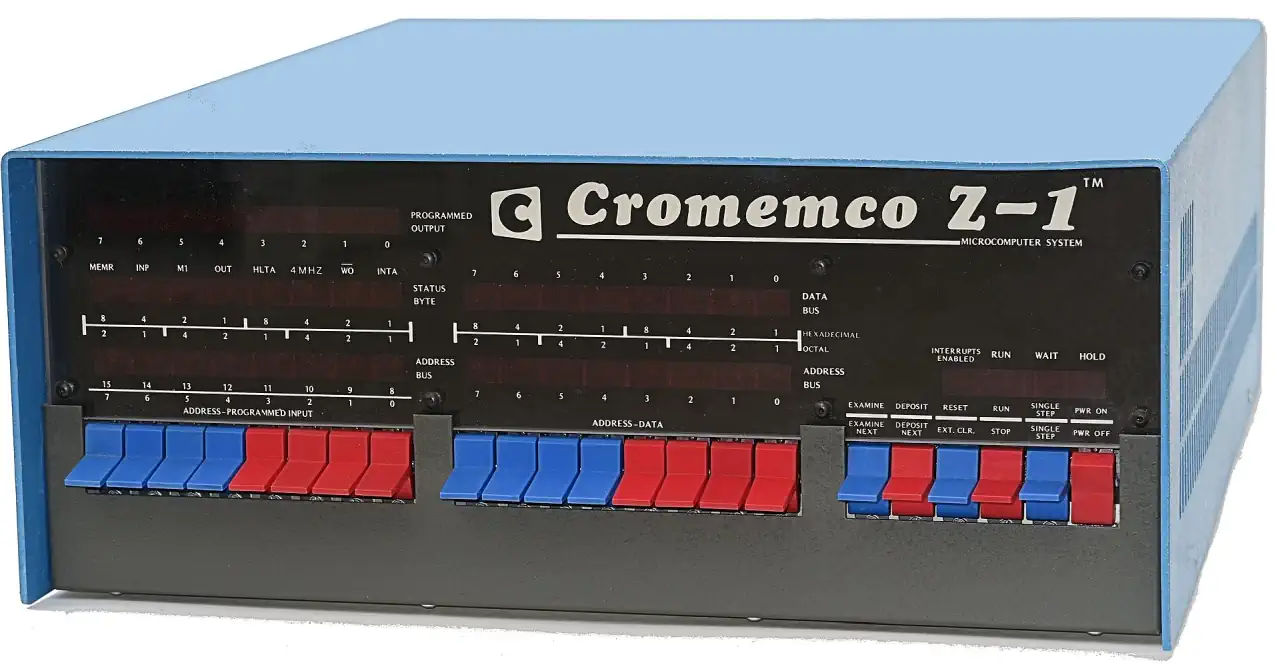

The Cromemco Z1 system
Architecture and the S-100 Bus Implementation
The Cromemco Z-1 represents a pivotal moment in S-100 bus evolution, packaged in a heavy-duty rack-mount chassis inherited from the IMSAI 8080. Unlike its predecessors that relied on the Intel 8080A, the Z-1 was built around the Cromemco ZPU card utilizing the Zilog Z80 microprocessor. This allowed for binary compatibility with 8080 code while introducing an expanded instruction set and the ability to run at a 4 MHz clock speed though it defaulted to 2 MHz for compatibility with slower legacy S-100 cards. The system architecture utilized a 21-slot backplane, providing massive extensibility for a variety of proprietary and third-party interface cards.Memory Mapping and Storage Subsystems
A distinguishing technical feature of the Z-1 was its reliance on the Cromemco 4KZ RAM cards and the 16KPR ROM board. The 16KPR was essential for the "Bytesaver" functionality, allowing for the burning and execution of EPROMs directly on the bus. In its standard configuration, the Z-1 lacked an integrated disk controller, often requiring the addition of the Wangco 5.25-inch floppy drives and the 4FDC Disk Controller card. This controller was notable for its integrated RS-232 serial port and a dedicated 1K monitor program (RDOS) residing in ROM, which handled the initial bootstrap process and low-level hardware debugging without requiring front-panel toggle sequences.Cromemco Z-1 Architecture
The Cromemco Z-1 was the immediate predecessor to the Z-2 and was essentially a heavily modified IMSAI 8080 chassis. Because it shared the same S-100 bus architecture, its video and sound capabilities were nearly identical to the Z-2D, though it was often paired with earlier versions of the hardware.Technical summary
| Feature | Typical Z-1 Hardware | Output Type |
|---|---|---|
| Color Video | Cromemco Dazzler (Original) | NTSC / RGB |
| Audio Output | D+7A I/O Board | 8-bit Analog DAC |
| Control Interface | Front Panel Switches/LEDs | Binary Visual Feedback |
| Text Display | Serial I/O (TU-ART) | RS-232 Terminal |
Power Supply and Thermal Management
To support a fully populated 21-slot backplane, the Z-1 featured a robust linear power supply capable of delivering 28 Amps at 8V DC and 3 Amps at +/- 18V DC This unregulated DC voltage was then stepped down via TO-3 local regulators on each individual S-100 card, a design choice that mitigated voltage drops across the backplane but generated significant heat. To manage the thermal load of multiple NMOS logic chips and power regulators, the Z-1 utilized a high-CFM rear-mounted cooling fan, ensuring laminar airflow across the vertically oriented cards to prevent logic errors or component failure during continuous operation.Differences between IMSAI 8080 and the Z-1 CPU
| Feature | IMSAI 8080 (Standard) | Cromemco Z-1 (ZPU) |
|---|---|---|
| Central Processor | Intel 8080A | Zilog Z80 / Z80A |
| Clock Frequency | 2.0 MHz | 2.0 MHz / 4.0 MHz (Switchable) |
| Instruction Set | 78 instructions | 158 instructions (includes 8080 set) |
| Registers | 7 (A, B, C, D, E, H, L) | 18 (adds IX, IY, and alternate bank) |
| Interrupt Modes | Mode 0 (Standard) | Modes 0, 1, and 2 (Vectored) |
| Power Rails | +5V, -5V, +12V | +5V (Single voltage CPU) |
| DMA Support | Limited / External Logic | Native Z80 DMA Protocol |
Cromemco Model Comparison
Cromemco's product line expanded significantly from its early S-100 boards into a diverse range of systems. While the Z-2 series was their most iconinc, they offered everything from entry-level systems to high-end unix-like workstations.
Here is an overview of the other major models available
The System Series
- System Zero (CS-0): A compact, low-cost entry point. It was designed primarily for ROM-based applications but could be expanded to support disks. It used the SCC (Single Card Computer) as its heart.
- System One (CS-1): A smaller, 8-slot desktop version of the Z-2D. It was aimed at the office environment and was often the first to ship with the newer 5.25-inch "quad capacity" floppy drives.
- System Three (CS-3): The "professional" flagship. It was a massive cabinet system featuring dual 8-inch floppy drives (Persci 277) and 21 slots. It was designed specifically for multi-user environments running the Cromix operating system.
- C-10 Personal Computer: A departure from the S-100 "big iron." This was an all-in-one style desktop (similar to a Kaypro or early Mac) with a built-in monitor, Z80A CPU, and 64K RAM, bundled with a suite of business software.
Evolution to 16/32-bit
By the mid-1980s, Cromemco moved beyond the Z80. They introduced the DPU (Dual Processor Unit) which allowed these same chassis to run both a Z80 and a Motorola 68000 This eventually led to the CS-200 and CS-400 series, which were tower-style units designed as powerful Unix servers for the scientific community.
| Model | Architecture / Chassis | Typical Use Case |
|---|---|---|
| System Zero | 4-Slot S-100 / Compact | Dedicated Control / ROM Software |
| System One | 8-Slot S-100 / Desktop | Small Business / Single User |
| System Three | 21-Slot S-100 / Large Cabinet | Multi-user Unix-like (Cromix) |
| C-10 | Integrated Monitor / Non-S100 | Personal Productivity / Word Processing |
| System 100/200 | 68000-based S-100 Tower | High-end Unix Server |
The S-100 Architecture
The S-100 bus formalized as IEEE 696 is a passive backplane architecture originally designed for the MITS Altair 8800. Unlike modern active motherboards, the S-100 backplane contains no active logic; it consists of 100 parallel trace lines with physical slots for daughtercards. The original specification utilized a 100-pin edge connector to facilitate a 15.5-inch wide bus. Because it was designed around the Intel 8080, the signal definitions closely mirrored that processor’s pinout, including specialized status signals such as sMEMW (memory write) and sINP (input from I/O port).
Power distribution on the S-100 bus is characterized by its use of unregulated DC voltages: +8V +16V and -16V This necessitated the inclusion of local voltage regulators—typically TO-3 or TO-220 packages—on every individual expansion card to step the voltage down to the required TTL-level +5V or +/- 12V. While this distributed regulation increased the thermal load of each card, it effectively isolated noise and voltage drops across the long backplane traces, a critical factor for maintaining signal integrity in high-density 21-slot systems like the Cromemco Z-1.
The bus timing and control logic rely on a "master-slave" relationship, where a single CPU card typically acts as the permanent bus master. However, the IEEE 696 standard introduced a sophisticated Temporary Master protocol, allowing for up to 16 different bus masters. This is managed through four prioritized DMA control lines (HOLD pHLDA and the ADSB address disable signals). When a secondary controller, such as a high-speed disk interface, requires the bus, it asserts a request; the primary CPU then tri-states its address, data, and control buffers, effectively disconnecting from the bus to allow the temporary master full transparent access to the system memory.
Data handling on the S-100 bus was originally limited to 8-bit bidirectional communication, but the transition to 16-bit processors necessitated the implementation of the sXTRQ (Sixteen Request) and SIXTN (Sixteen Acknowledge) signals. These pins allow the bus to dynamically gang two 8-bit data paths (Data-In and Data-Out) into a single 16-bit wide data bus. Combined with a 24-bit extended addressing scheme—utilizing pins 12 through 17 and 59 through 64—the S-100 architecture successfully scaled from 64 KB of addressable space to a 16 MB range preserving its relevance through the early 1980s.
CPU - The Zilog Z80
The Z80 quickly became popular in the personal computer market, with many early personal computers, such as the TRS-80 and Sinclair ZX80, using the Z80 as their central processing unit (CPU). It was also widely used in home computers, such as the MSX range, SORD, and the Amstrad CPC, as well as in many arcade games. Additionally, it was also used in other applications such as industrial control systems, and embedded systems. The Z80 was widely used until the mid-1980s, when it was gradually replaced by newer microprocessors such as the Intel 80286 and the Motorola 68000.
The Z80 microprocessor was developed by Zilog, a company founded by Federico Faggin in 1974. The Z80 was released in July 1976, as a successor to the Intel 8080. It was designed to be fully compatible with the 8080, but also included new features such as an improved instruction set, more powerful interrupts, and a more sophisticated memory management system.
Originally the Z80 was intended for use in embedded systems, just as the 8080 CPU. But the combination of compatibility, superior performance to other CPUs of the era, and the affordability led to a widespread use in arcade video game systems, and later in home computers such as the Osborne 1, TRS-80, ColecoVision, ZX Spectrum, MSX, Sega's Master System and many more. The Z-80 ran the original Pac-Man arcade cabinet. The Z-80 was used even in the Game Gear (1990s), and the TI-81 and succeeding graphic calculators.
The Z-80 remained in production until June of 2024, 48 years after its original release. Zilog replaced the processor with its successor the eZ80, an 8-bit microprocessor that features expanded memory addressing up to 16 megabytes, and running up to 50MHz, comparable to a Z80 clocked at 150MHz.