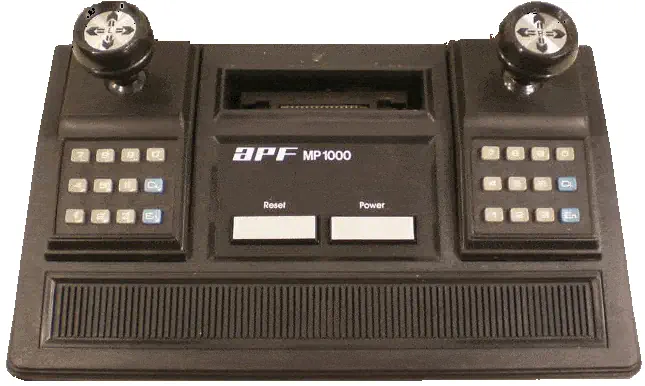

APF MP-1000
The APF Microcomputer System, also known as M-1000 or MP-1000, is a second-generation 8-bit cartridge-based console released in 1978. Developed by Ed Smith, it comes with a built-in game, Rocket Patrol.
The machine offers graphics that were advanced for its time, 256x192 pixels in 8 colors. The MP-1000 was part of the APF Imagination Machine. This consisted of two parts: the MP-1000 and a docking-bay that included a full-sized typewriter style keyboard making it possible to learn to program and create games fo the machine.
Here is a list of 13 games that came out for the MP-1000:
- MG1001 - Built in: Rocket Patrol
- MG1002 - Catena
- MG1003 - Hangman, Tic Tac Toe, Doodle
- MG1004 - Bowling, Micro
- MG1005 - Brickdown, shooting gallery
- MG1006 - Baseball
- MG1007 - Blackjack
- MG1008 - BackGammon
- MG1009 - Casino I: Roulette, Keno, Slots
- MG1010 - UFO, Sea Monster, Break it down, Rebuild, Shoot
- MG1011 - Pinball, Dungeon hunt, Blockout
- MG1012 - Boxing
- MG1013 - Space Destroyers (Space Invanders)
CPU - The Motorola 6800
The 6800 is an 8-bit microprocessor designed by Motorola in 1974. The processor was developed as part of the M6800 Microcomputer System that was announced in the same year.
The 6800 has a 16-bit address bus that can directly access 64KB of memory and an 8-bit bi-directional databus. The CPU has a total of 72 instructions using seven different addressing modes, resulting in 197 opcodes. The original 6800 used a clock frequency of up to 1 MHz, while later versions increased this limit to 2MHz.
The 6800 was used in various computer systems and point of sale terminals. It can also be found in older arcade systems and pinball machines. It was succeeded by the MC6802 which was released in 1977. This CPU had 128 bytes of RAM on board and an internal clock oscillator. The later produced Motorola 6809 was stil backwards compatible with the 6800.
Video - Motorola MC6847 VDG
The Motorola MC6847 is a versatile Video Display Generator (VDG) introduced in 1978, designed to interface between microprocessors and television circuitry. It was a staple of early 8-bit computing, most notably powering the TRS-80 Color Computer and the Dragon 32/64 The chip is capable of generating both alphanumeric text and bitmapped graphics in several distinct modes, utilizing an internal ROM for character generation or external RAM for high-resolution graphics. It outputs a composite video signal in NTSC format, though variants like the MC6847Y and MC6847P were used for different clocking and signal requirements.
Hardware Interface and Signal Logic
The MC6847 operates on a 3.579545 MHz clock—the standard NTSC colorburst frequency—which it uses to derive all internal timing for horizontal and vertical synchronization. It features an 8-bit data bus and a series of mode-select pins (GM0, GM1, GM2, S/A, Int/Ext, CSS that determine the display format. Because the VDG and the CPU (often the MC6809) must share access to the same bank of video RAM, the chip provides a Device Busy (DB) signal or works in tandem with a synchronous address multiplexer (like the MC6883 SAM) to prevent "snow" or bus contention during the active display cycle.
Alphanumeric and Semigraphics Modes
In its base Alphanumeric mode, the MC6847 displays a 32x16 grid of characters. It features an internal character generator ROM that produces a limited 5x7 pixel font within an 8x12 pixel block. A unique feature of this chip is its Semigraphics modes (SG4, SG6, SG8, SG12, etc.), which divide each character block into smaller "pixels" or sub-blocks. For instance, Semigraphics 4 divides a block into a 2x2 matrix, allowing for a pseudo-graphics resolution of 64x32 while still treating the data as ASCII-like character bytes, which significantly reduces the memory overhead for the host system.
High-Resolution Graphics and Color Palette
The chip’s true bitmapped graphics modes, referred to as "Full Graphics," range from Resolution Graphics One (RG1) at 64x64 pixels to High-Resolution Graphics Six (RG6) at 256x192 pixels. At its highest resolution, the MC6847 is limited to a monochrome (two-color) display due to the 6KB memory ceiling of the addressing scheme. In lower-resolution modes, such as 128x192, it supports a four-color palette. The color selection is governed by the Color Set Select (CSS) pin, which toggles between two hardware-defined palettes:
- Palette 0: Green, Yellow, Blue, Red.
- Palette 1: Buff (White), Cyan, Magenta, Orange.
Memory Addressing and Video Synthesis
The MC6847 does not have internal RAM; instead, it generates a 13-bit address bus (DA0–DA12 to fetch data from external memory. As the electron beam scans the television screen, the VDG continuously cycles through the memory locations, converting the retrieved bytes into a serial bitstream. This stream is then processed by the internal luminance (Y) and chrominance (phi-A, phi-B) modulators. Because the chip was designed for cost-effective home electronics, it handles the complex task of NTSC color encoding internally, requiring only a minimal external buffer and an RF modulator to produce a signal a standard television can interpret.